Most brands in India get the product right. The space is where things unravel.
Walk into any underperforming retail store and the merchandise is rarely the problem. It is the fixtures placed in the wrong sequence. Lighting that flattens everything it touches. Sightlines that make a 1,200 sq ft floor feel like a service corridor. The right retail interior designers in Delhi do not just make spaces look good – they make spaces sell. Brands that treat that distinction as minor tend to figure out why it matters only after the budget is gone.
This is a guide for retail and brand decision-makers shortlisting, evaluating, or close to contracting a design partner for a physical store in Delhi. No preamble about why good design matters – if you are reading this, you already believe that. The question is how to find someone who can actually deliver it.
The selection problem most brands underestimate
Delhi has no shortage of interior designers. A decent portfolio is easy to find. Finding a firm that can design and build a retail space to a commercial brief – on time, within a controlled budget, with materials that hold up to daily footfall – that is a much shorter list.
The confusion starts because retail interior work sits at an unusual intersection. It needs the rigour of a construction project and the sensibility of a brand exercise. Pure architects tend to underestimate the commercial logic of a retail floor. Pure decorators underestimate the structural and procurement complexity. The firms that do both well have typically built a hybrid capability over years of actual site experience, not just studio work.
When you are evaluating retail interior design companies, one of the earliest questions worth asking is: do you design and build in-house, or do you hand off to contractors once the drawings are done? The answer tells you a great deal about what accountability looks like when something goes wrong on site.
What a retail space actually needs to do
Before evaluating any design firm, it helps to be clear on this. A retail store is not a showroom photograph. It is a working sales environment that has to:
- Direct footfall without feeling forced or manipulative
- Put the right products at the right eye level at the right moment in the customer journey
- Balance brand identity with operational practicality – storage, staff movement, POS placement
- Survive real-world use: daily cleaning, restocking, seasonal changes, and the occasional rough handling
- Communicate brand values without a single word of signage, through material, light, and space alone
That last point is the one most often underweighted in briefs. A customer who walks into a well-designed store does not think “great design.” They just feel comfortable, curious, and inclined to stay longer. That feeling is engineered, not accidental.
How to evaluate retail interior designers in Delhi
Start with the brief, not the portfolio
Most brands begin with mood boards and finish with budgets. Reverse that process. Define what the store has to do commercially before you look at a single visual reference. What is the average transaction size? How does the customer typically browse? Is the goal dwell time, conversion rate, or basket size? These answers shape spatial decisions more than aesthetic preferences do.
Once you have the commercial brief clear, then use the portfolio to assess whether a firm has solved similar problems before.
Look for category depth, not just a long project list
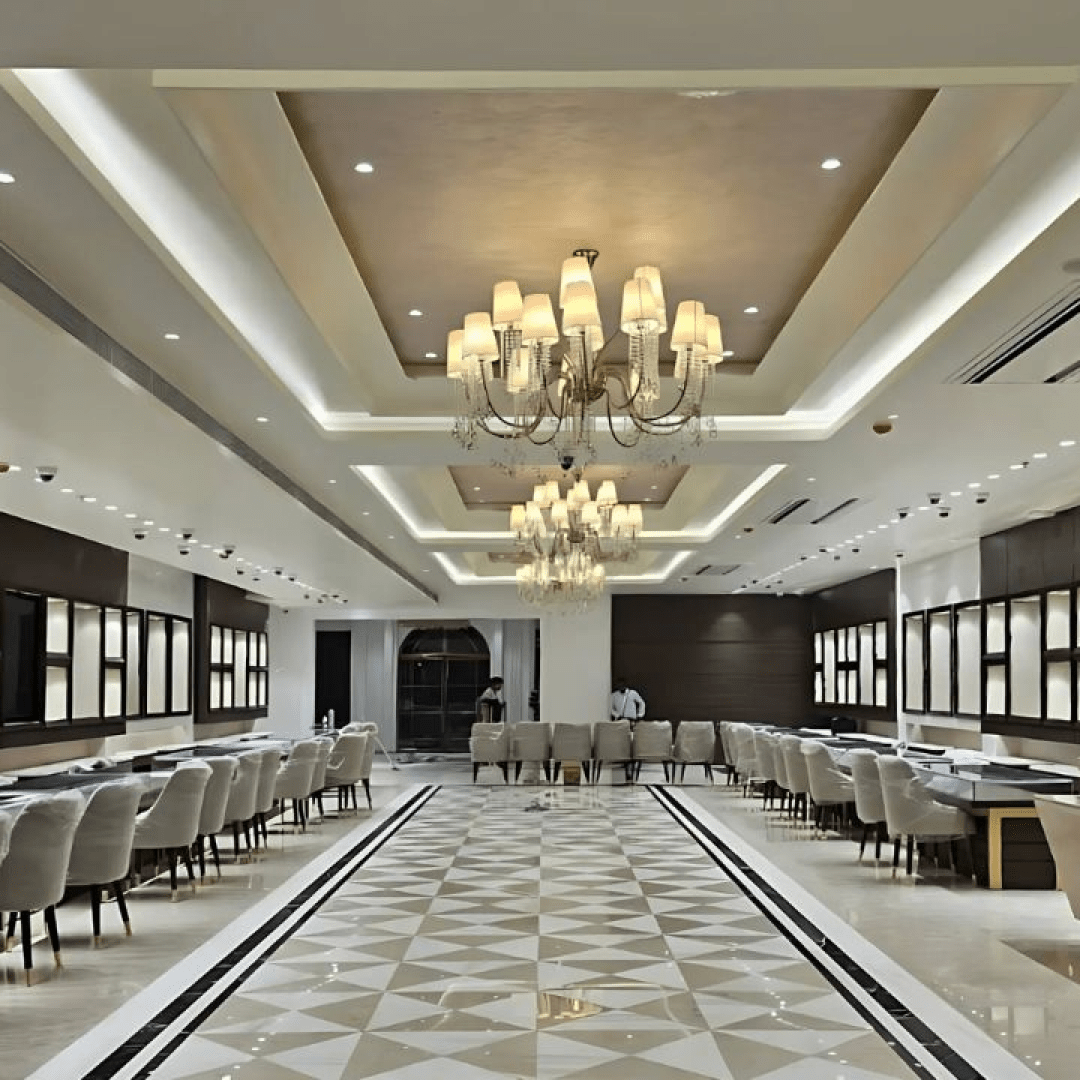
A retail fit out company with 50 projects in one category will often outperform one with 200 projects across random sectors. If you are opening a jewellery store, the firm’s experience with jewellery retail – display logic, lighting for precious metals, security integration in the design – is more relevant than a mixed portfolio that happens to include one jewellery project.
Ask to see three to five projects similar in type and scale to yours. If they cannot produce that, you are probably not a fit.
Test their manufacturing capability
This is the most underrated filter in the entire selection process. Custom retail fixtures – display counters, wall cladding systems, backlit panels, bespoke shelving – do not come off a catalogue. They are made. And whether they are made well, delivered on time, and match the design on site depends entirely on whether the firm has real manufacturing capability or is just coordinating with vendors they do not control.
Ask: do you have your own production facility? What is your lead time for custom fixtures from design sign-off to delivery? What happens if a piece does not match the approved sample?
A retail store design company with in-house manufacturing answers these questions with specifics. One without will give you generalities.
The Delhi retail market: what is actually being built right now
Delhi NCR’s retail expansion has not slowed down. If anything, it has diversified. The formats being built right now span:
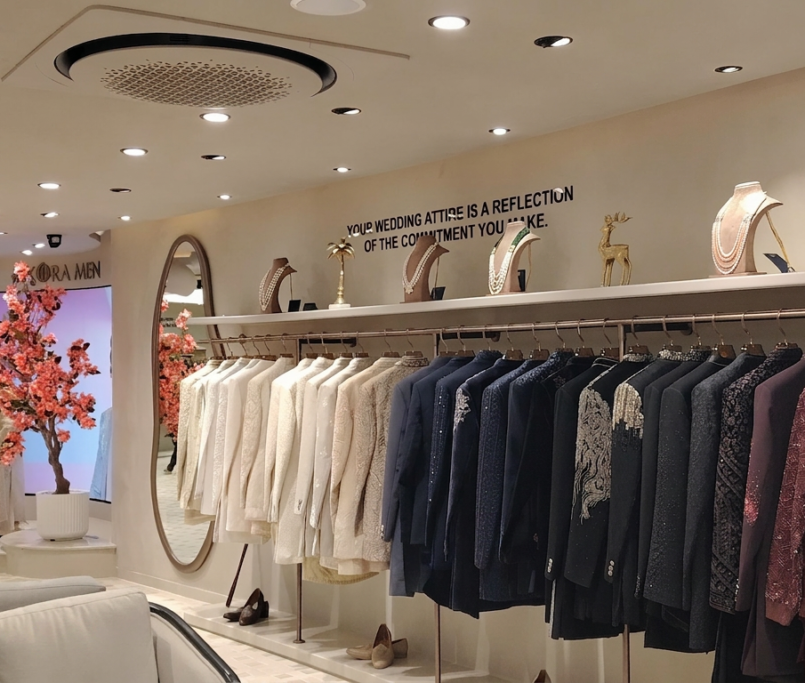
- Luxury and premium retail in Select Citywalk, DLF Emporio, and Khan Market
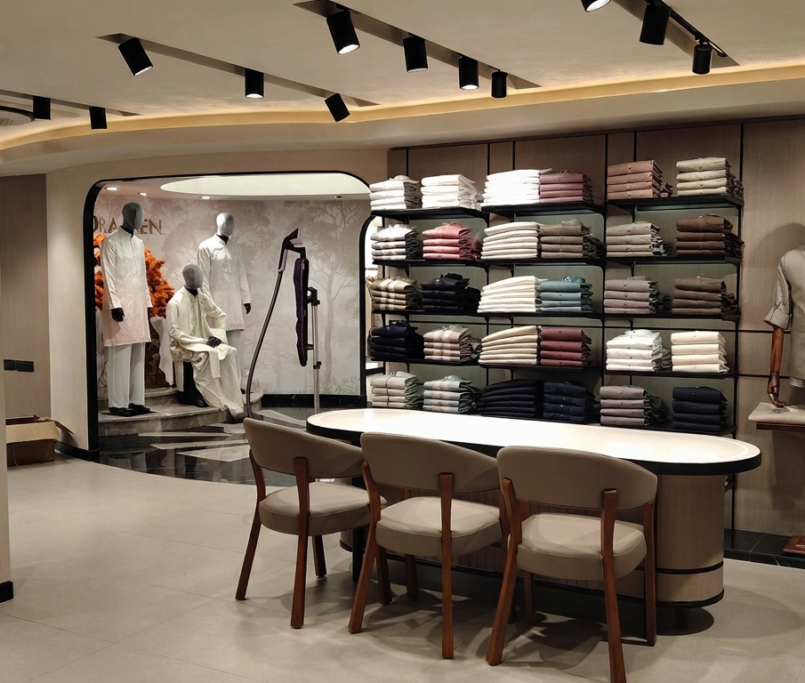
- High-street fashion in Saket, Rajouri Garden, and Lajpat Nagar
- Jewellery showrooms in Karol Bagh, Pitampura, and across Delhi NCR’s expanding residential corridors
- Mono-brand flagship stores anchored around experiential retail, not just product display
- Quick-service F&B retail concepts with branded interiors and high turnover requirements
Each of these formats has its own commercial logic, its own material requirements, and its own relationship between design and daily operations. The retail interior design companies that have worked across this range think differently from those that have only served one segment.
The questions that actually matter before you sign
Most vendor conversations get stuck on rates and timelines. Those matter, but they are not the right starting point. Before committing to any design partner for a Delhi retail project, work through these:
- What is your process from brief to concept sign-off, and how long does it typically take?
- Who is the project manager on our account, and will they be on site during execution?
- How do you handle material substitutions if a specified item is not available or has a long lead time?
- What does your contract look like – turnkey, phased, or design-only?
- What are the most common reasons your projects run over timeline, and what do you do about them?
- Can I speak to two or three clients from the last twelve months?
A firm that handles these questions confidently, with real examples, is worth continuing the conversation with. One that pivots quickly to rate cards is probably more interested in closing than in delivering.
What the shortlist should look like
By the end of your evaluation process, you want three firms, not ten. Ten is just noise. Three is a manageable comparison on design thinking, manufacturing capability, execution track record, and commercial fit.
The criteria to weight in your shortlist:
- Relevant category experience in retail specifically
- Demonstrated in-house manufacturing capability
- A project management structure that does not vanish after concept sign-off
- References from brands that opened on or near the promised date
- A design sensibility that can subordinate itself to your brand identity rather than trying to impose one
That last point trips up a lot of otherwise capable firms. The best retail design partners are the ones who can set their aesthetic preferences aside and solve your commercial brief – even when the brief is less exciting than what they would design for themselves.
A space that earns its rent every day
The real measure of a retail interior is not how it looks on opening day. It is how it performs six months in, when the novelty has worn off and the space has to work on its own commercial merit every single day.
That means the fixtures are still holding up. The lighting still does what it was supposed to do. The flow is still directing customers the way it was designed to. And the brand feeling – whatever it was meant to be – has not eroded because the materials aged badly or the design was too clever to be practical.
Good retail interior work is invisible in the best sense. It does not demand attention. It just sells.
Atmosphere is a Mumbai-based commercial fit-out company with an in-house manufacturing facility and a portfolio across retail, jewellery, hospitality, and workspace for brands across India. As a retail store design company that handles design, manufacturing, and site execution under one roof, they are built for retail briefs where aesthetics and commercial performance both have to be right. Worth a conversation if you are shortlisting for a retail project in Delhi or elsewhere in India.