
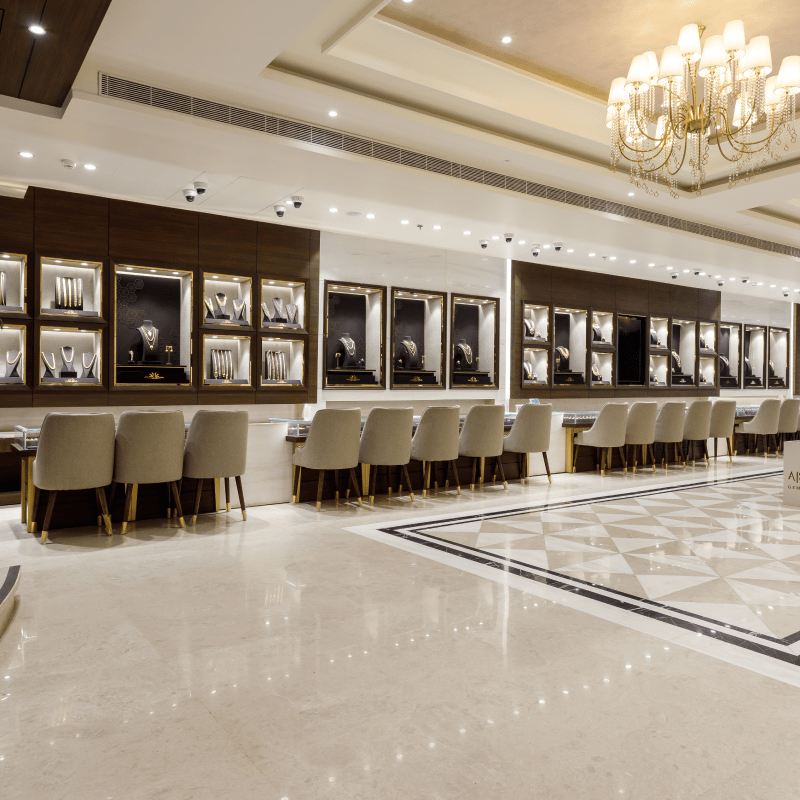
High-end jewellery showroom design: layout and lighting guide
Two showrooms. Same city. Same tier. Same product category. One converts consistently. The other struggles to hold customers past the first five minutes.
The difference, in almost every case, comes down to two things: how the floor is laid out and how the product is lit. Not the brand name on the fascia. Not the square footage. Not even the quality of the merchandise on display. Layout and lighting are the invisible machinery behind every high-performing luxury jewellery store interior – and they are also the two things most commonly treated as afterthoughts in the Indian jewellery retail build process.
This guide works through both in detail. It is written for jewellery brands, showroom owners, and retail decision-makers who are either building from scratch or rethinking an existing space that is not performing the way it should.
Why layout and lighting deserve a guide of their own
Most conversations about jewellery showroom design start with finishes. What marble for the floor. What colour for the walls? What style for the fixtures. These are real decisions, but they are downstream ones. They dress a space that already exists in plan form.
Layout and lighting, on the other hand, are structural. Change them and you change the commercial behaviour of the space – how long customers stay, which products they engage with, how often a browsing visit becomes a buying one. Change the marble and you change the look. Change the layout and the lighting and you change the numbers.
That is why they come first.
Layout: the floor plan as a selling system
The entry zone
Every high-performing jewellery showroom has a moment of deceleration at the entrance. Not a physical barrier – a spatial one. A slightly different ceiling height, a change in flooring material, a visual pause before the merchandise begins.
This transition matters more in jewellery retail than in almost any other category. A customer walking in from a busy street or a mall corridor is not yet in the right mental state to examine a piece worth several lakhs. The entry zone is where that shift happens. If the display counters begin immediately at the door, the brand is forfeiting that transition entirely.
The practical size of this zone depends on the total floor area. In a 1,500 sq ft showroom, two to three metres of considered entry space is enough. In a larger format, it can be more deliberate – a reception point, a seating arrangement, a feature wall that orients the customer before the product journey begins.
Counter placement and customer flow
Jewellery showroom interior design that works commercially is built around one central question: how does the customer move through the space, and what do they encounter at each point in that movement?
A few layout principles that hold across most showroom sizes and formats:
Organise by customer decision-making sequence, not by product category alone
Entry-level and accessible price points near the front, signature and high-value pieces deeper in the space. This is not about hiding the premium product – it is about earning the customer’s trust and attention before placing your highest-value pieces in front of them.
Create natural pause points rather than continuous counter runs
A customer who walks along an unbroken wall of display cases is in transit mode. Break the run with a recessed alcove, a consultation seating area, or a change in counter height, and the customer shifts into examination mode.
Separate browsing zones from consultation zones spatially
The moment a customer sits down to evaluate a shortlist, the environment needs to change. Lower light levels, more privacy, less through-traffic. If the consultation happens in the same visual environment as the browsing, the customer never fully transitions from looking to deciding.
Circulation and spatial generosity
High-end jewellery retail cannot be cramped. The customer spending significant money needs to feel that the space around them matches the weight of the decision they are making. Tight aisles, counters placed too close together, staff and customers occupying the same narrow channels – these create a low-grade discomfort that customers attribute to the brand rather than to the floor plan.
Counter-to-counter clearance in luxury jewellery store interiors should allow two customers to stand at adjacent displays without any sense of encroachment. Staff circulation paths should not run through customer browsing zones. Where the floor plan cannot achieve this with the current counter configuration, the answer is fewer counters, not narrower aisles.
Lighting: the element that determines what the customer actually sees
Why jewellery lighting is a specialist brief
Standard retail lighting and jewellery lighting are not the same discipline. In most retail categories, the goal of lighting is to make the product visible and the environment appealing. In jewellery retail – particularly in diamond and precious gemstone categories – the lighting is the primary factor in how the product looks.
A diamond that shows full brilliance and fire under the right light source looks flat and lifeless under the wrong one. A piece of polished gold that glows warmly under a 3,000 Kelvin source looks cold and metallic under a 5,000 Kelvin one. These are not subtle differences. They are the difference between a customer who reaches for a piece and one who moves past it.
The retail fixture and furniture specification and the lighting specification need to be developed together, not sequentially. Case material, glass type, tray colour, and light source angle all interact. A decision made on one without reference to the others produces unpredictable results.
Colour temperature and CRI: what they mean in practice
Two numbers matter in jewellery lighting more than any others.
Colour temperature, measured in Kelvin, determines whether the light appears warm or cool. For most jewellery categories – particularly gold, rose gold, and warmer gemstone settings – a range of 2,700 to 3,200 Kelvin produces the most flattering result. For diamond display and platinum settings, 3,500 to 4,000 Kelvin shows the stone’s character more accurately.
Colour Rendering Index, or CRI, measures how accurately a light source renders colour compared to natural light. For jewellery retail, CRI 90 is a minimum standard. CRI 95 and above is where the product genuinely comes alive. Low CRI sources – anything below 85 – make coloured gemstones look dull and diamonds look lifeless regardless of their actual quality.
These numbers should be in every lighting specification for a jewellery showroom. If they are not, the lighting decision is being made without the information needed to make it correctly.
Layered lighting: ambient, accent, and task
A jewellery showroom interior design that relies on a single lighting layer – typically recessed ceiling downlights – is working at a significant disadvantage.
The approach that works is layered:
- Ambient lighting sets the overall mood and brightness of the space. In a high-end showroom, this should be relatively low – warm, controlled, creating an environment that feels considered rather than clinical.
- Accent lighting is directed at the display cases and is the primary light source for the product. This is where the CRI and colour temperature specifications matter most. Narrow-beam LED spotlights, precisely angled to hit the stone or piece at the right incidence angle, do the selling work.
- Task lighting serves the consultation area – bright enough for the customer to examine a piece in detail, but controllable so it does not compromise the ambient mood of the rest of the space.
Getting the balance between these three layers right is the difference between a showroom that feels like a destination and one that feels like a well-lit storage room.
Fixtures and furniture: where the brief becomes physical
Retail fixtures and furniture in jewellery retail carries a heavier brief than in most other categories. The display case is not just a container. It is the last physical interface between the product and the customer.
What that means practically:
- Glass specification affects product perception directly. Anti-reflective coated glass eliminates the visual noise between the customer and the piece. Standard float glass introduces reflections that distract from the stone itself. In a high-end context, this is not a detail to value-engineer out.
- Counter ergonomics determine how long a customer will examine a piece. A counter height that forces a customer to stoop, or a case angle that creates glare at typical viewing height, shortens the examination window. Shorter examination = lower conversion on high-value pieces.
- Tray and mount design should serve the product, not the display. Overly ornate mounts compete visually with the jewellery. The best display infrastructure in high-performing showrooms is almost invisible – present enough to hold and position the piece correctly, restrained enough to keep all attention on the product itself.
The brief that gets the best results
Bring layout, lighting, and fixture specification into a single integrated brief from day one. Not three separate conversations with three separate vendors.
The brands that build showrooms which genuinely perform – not just in the first month, but in the third year – are the ones where the floor plan, the lighting design, and the fixture manufacturing were developed as a single coherent system. Where a change to the counter configuration prompted a relook at the lighting angle. Where a material selection for the case interior was made with reference to the specific light source that would be used above it.
That level of integration requires a fit-out partner who can hold all of it. Not just design it.