Bangalore does not forgive a slow opening.
The city’s F&B market moves at a pace that punishes delays the way few other Indian markets do. A restaurant that was supposed to open in October and opens in February has missed the festive quarter, the year-end corporate dining rush, and several months of rent on a space that was not generating a single cover. The project that took too long does not just cost money – it costs the window.
This is why the conversation around restaurant interior designers in Bangalore has shifted from “who does the best work” to “who does the best work and delivers it.” That second part is no longer a bonus. It is the baseline.
Hospitality design and build services exist precisely to collapse the gap between a signed brief and an open restaurant. Not by cutting corners on design but by building a model where design and construction are managed as one continuous process rather than two sequential ones that hand off imperfectly at a critical juncture.
What design and build actually changes
Most restaurant fit-outs in India follow the same structural pattern. An interior design firm is engaged, concepts are developed over several weeks, drawings are produced, and then a separate contractor is appointed to execute them. At this handoff point – drawings to contractor – a surprising amount of what was designed either becomes more expensive to build than anticipated, requires modification because the contractor cannot source the specified materials, or simply takes longer than the original timeline assumed.
None of this is negligence. It is a structural problem. A design firm optimising for the quality of the outcome and a contractor optimising for the efficiency of execution have different incentives. When they are separate entities, those different incentives produce friction. That friction shows up as timeline slippage, budget variance, and the particular exhaustion of a restaurant owner who is simultaneously managing two vendor relationships that each have legitimate grievances with the other.
Hospitality design and build services replace this structure with a single point of ownership. The firm that designs the restaurant is the same firm that builds it, manufactures its custom elements, and is accountable for handing it over on the agreed date. The incentives are aligned because the accountability is unified.
Bangalore’s restaurant market: what the brief actually needs to carry
Before the design conversation begins, the brief needs to reflect how Bangalore’s restaurant market operates in practice.
A few things that are specific to this city:
- Neighborhood character varies dramatically and quickly. Koramangala, Indiranagar, Jayanagar, Whitefield – these are not interchangeable catchments. The customer in each has a different profile, a different expectation of price point, and a different relationship with dining as a social activity. The interior brief should be built around the specific neighbourhood, not around a generic Bangalore customer.
- The weekend-weekday split is pronounced. Many Bangalore restaurants run at near-capacity on Friday and Saturday evenings and at a fraction of that during weekday lunch service. A space designed only for peak capacity performs poorly during the hours it most needs ambient energy to attract walk-in traffic.
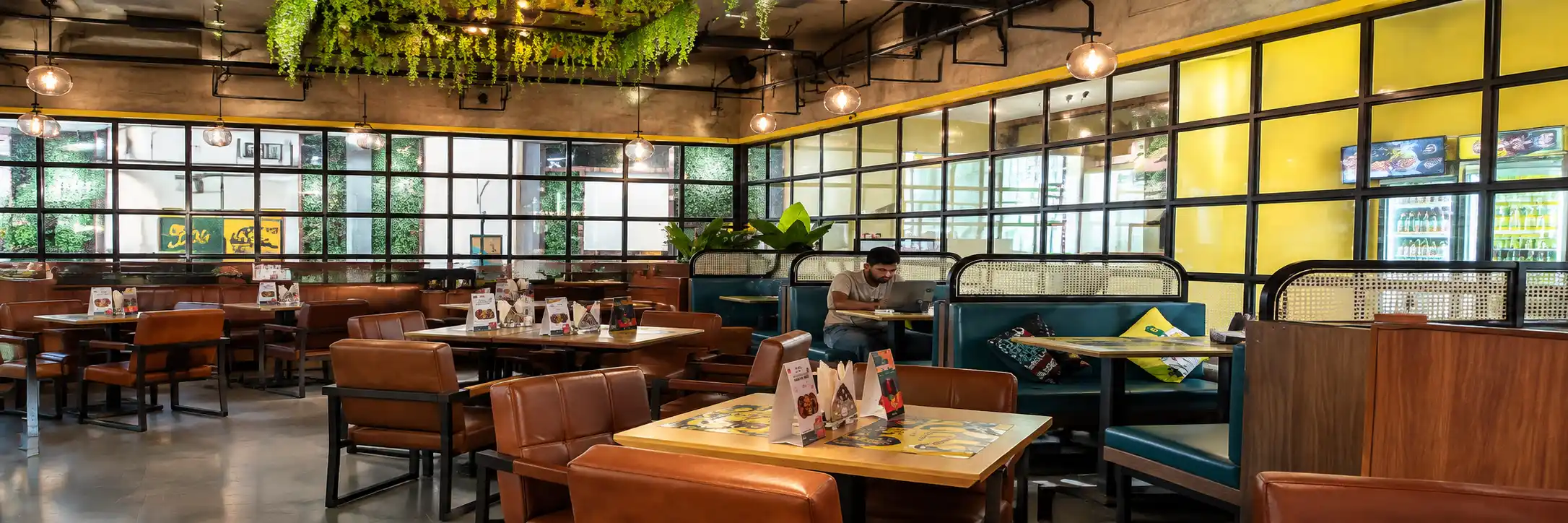
- The work-from-café culture is real and relevant. Bangalore has a substantial population of professionals who treat a restaurant or café as a work environment during off-peak hours. Spaces with zero provision for this – no power points accessible from seating, no acoustic buffer between zones – lose a significant daytime revenue stream.
Good restaurant interior design in Bangalore is a response to these specifics. Not to generic hospitality design principles, however well-established.
What the design and build process looks like in practice
The structure of a genuine design and build engagement is worth understanding before evaluating vendors.
- Brief and discovery phase: The design firm learns the brand, the operational model, the target customer, and the commercial targets for the space – not just the aesthetic preferences. This phase produces a spatial brief, not a mood board.
- Concept and space planning: Floor plan, customer flow logic, zoning, and the structural decisions about how the space will perform. This is developed with full awareness of what can be built within the timeline and budget, because the team designing it is the same team that will build it.
- Design development and manufacturing preparation: Working drawings are produced alongside manufacturing specifications for custom elements. Fixtures, furniture, cladding, and joinery go into production while civil work is being prepared on site – running parallel rather than sequentially.
- Site execution: Civil, MEP, and interior work sequenced and managed by the same organisation. No contractor blaming the designer and no designer blaming the contractor. One version of the timeline, owned by one firm.
- Finishing and handover: Custom elements installed against the approved design, snagging completed, and the space handed over ready to operate.
The parallel running of manufacturing and site preparation – possible only when both are managed by the same firm – is where significant time is saved on every project that does it correctly.
How to evaluate restaurant interior designers in Bangalore
The selection conversation should cover more than portfolio and rates.
- What was the last three projects’ committed versus actual delivery dates? This single question separates firms with genuine delivery capability from those with strong pitch capability. Both are common in Bangalore. They are not the same thing.
- Is manufacturing in-house or outsourced? Custom restaurant elements – bar counters, bespoke seating, branded millwork, speciality lighting fixtures – take time. Whether a firm controls that timeline or depends on vendors it does not manage determines how much of the project schedule is actually within its control.
- What is the project management structure during execution? Who is the on-site lead? How often does the design team visit the site? What is the process when a field condition requires a design modification?
- Does the firm have hospitality-specific experience, or is it general commercial with some F&B projects? The brief for a restaurant is different from the brief for a retail store or an office in ways that matter at every stage of execution. Category depth shows in how a firm talks about the brief before they talk about the design.
Restaurant interior designers in Bangalore who answer these questions with specifics rather than with generalities are worth continuing the conversation with.
The real cost of getting this wrong
A restaurant that opens three months late and a hundred square feet short of its seating capacity projection because the layout changed mid-construction is not a design failure. It is a process failure. And in Bangalore’s restaurant market – where launch momentum matters, where social media attention has a short half-life, and where the opening month often sets the trajectory for the first year – that failure has costs that never fully recover.
The brands that open well, open on time, and open into a space that immediately performs are the ones that treated the design and build relationship as a single brief from the beginning. They did not separate design from delivery. They did not treat manufacturing as someone else’s problem. They found a firm that owned the whole chain and held it accountable for all of it.
Restaurant interior design in Bangalore is not in short supply. The supply problem is in finding a firm that treats the opening date with the same seriousness it treats the opening look.