Bangalore builds fast and renovates faster.
The city’s commercial real estate cycle is unlike anywhere else in India. A tech company signs a lease, fits out a floor, grows by three hundred people in eighteen months, and is already looking at the next space. A retail brand opens in Indiranagar, reads the catchment wrong, redesigns the floor within a year. A hospitality group launches a property in Whitefield, watches the micro-market shift, and reconsiders the entire spatial brief six months in.
This pace creates a specific problem. Commercial interior designers in Bangalore are not in short supply. What is in short supply are firms that can match Bangalore’s commercial velocity – design fast, build with precision, deliver without the timeline drama that costs growing businesses real money. Finding one that does all three is the actual task, and most businesses in the city discover this only after they have hired the wrong firm and lived through the consequences.
This guide is for brands, business owners, and commercial decision-makers trying to navigate that selection. It covers what to look for, what to avoid, and how to think about the commercial interior brief before a single vendor conversation begins.
Bangalore’s commercial interior market: the landscape in 2025
Three overlapping markets define commercial interior work in Bangalore right now.
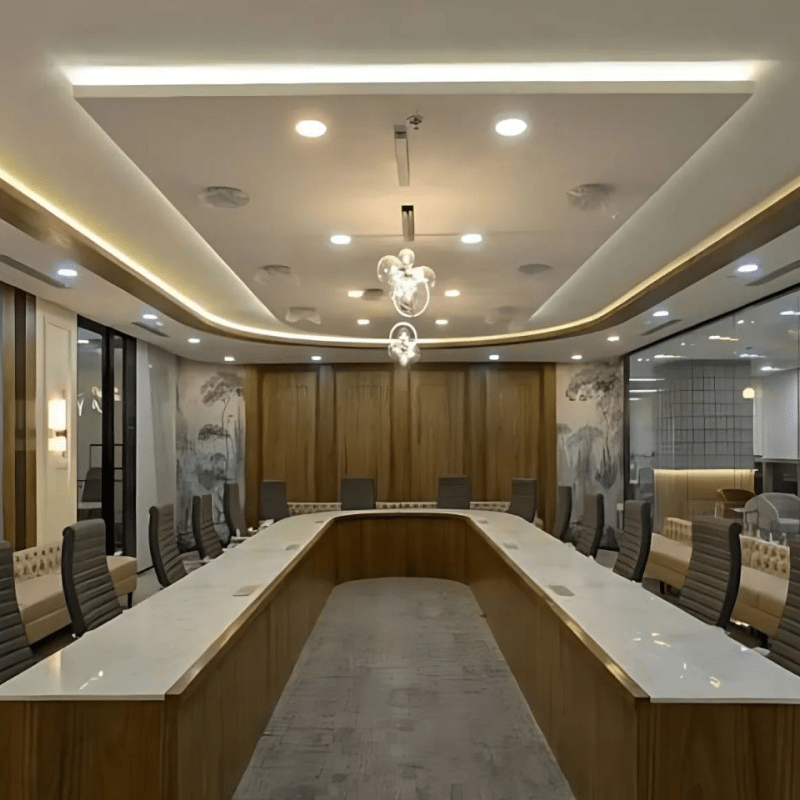
The first is corporate and technology workspace. Bengaluru remains the headquarters city for a substantial share of India’s tech sector, and the office fit-out market here is genuinely sophisticated. Tenants know what they want. Landlords have expectations. The gap between a generic office layout and one that actually supports how a modern tech company works has never been more visible – and never more commercially consequential in terms of talent retention and productivity.
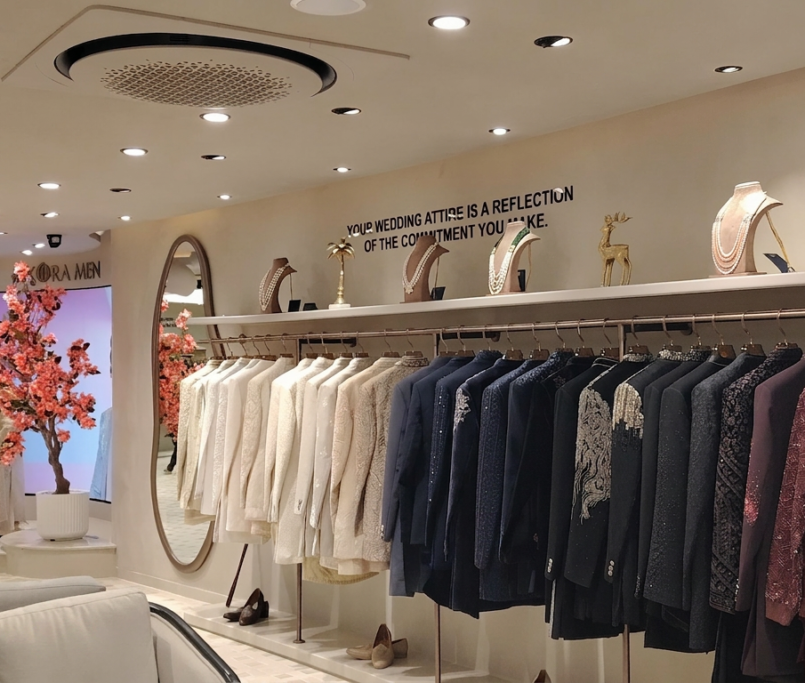
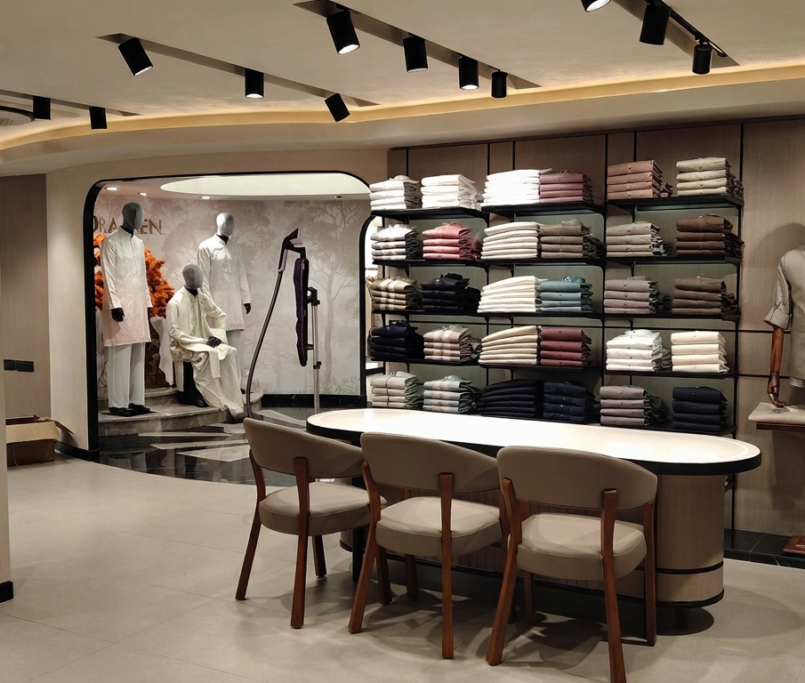
The second is retail and hospitality. Bangalore’s consumer market has depth across a wide range of formats – premium retail, quick service, fine dining, boutique hospitality – and the city’s design literacy among consumers is high. A space that would pass unremarked in a smaller city gets noticed here. For better or worse.
The third is the mixed-use and brand experience category – experience centres, showrooms, flagship stores, and brand environments that are neither pure office nor pure retail but borrow from both. This is where some of Bangalore’s most interesting commercial interior work is happening, and where the brief is most demanding because the design language has to carry brand identity as its primary load.
Each of these markets has its own commercial logic and its own demands on a fit-out partner. A firm that excels in corporate workspace does not automatically understand what a premium retail brief requires. Knowing which category your project sits in – and confirming that your vendor has relevant depth in it – is the starting point.
What “commercial interior” actually means as a brief
The phrase gets used loosely. Worth being specific.
A commercial interior is any space built primarily to support a business objective: sales, productivity, brand perception, customer experience, or some combination. What distinguishes it from residential or institutional work is that the interior has to earn its investment. Not look good. Earn.
That changes the design brief in a fundamental way. The question is not “what do we want this to look like?” The question is “what does this space need to do, and how does the design support that function?”
For a design and build interior company operating in Bangalore’s fast-moving commercial environment, this distinction is the difference between a firm that gives you a beautiful space and one that gives you one that works. The two are not always the same.
The case for turnkey: why it matters more in Bangalore than most cities
Bangalore has a time problem. Not a design problem.
The city’s commercial lease cycles, build-out timelines, and business growth rates all create pressure on project delivery. A corporate tenant with a twelve-week fit-out window cannot absorb a delayed contractor, a late material shipment, or a dispute between the interior design firm and the civil vendor about who is responsible for a snagging issue.
Turnkey commercial interiors solve this problem structurally. One firm, one contract, one point of accountability from brief to handover. Design, manufacturing, procurement, civil coordination, installation – owned by the same entity rather than orchestrated across vendors who have competing interests when things go sideways.
The alternative – appointing a design firm separately from a fit-out contractor, who subcontracts elements to suppliers they manage loosely – is how most commercial interior projects in Bangalore go over timeline and over budget. Not through negligence. Through the structural inefficiency of fragmented accountability.
When a single firm designs and builds, decisions made at design stage are informed by manufacturing reality. Lead times are known. Material availability is factored in. The site team and the design team speak the same language because they are the same organisation. That integration has a direct commercial value, and in Bangalore’s market, that value is measured in weeks.
How to evaluate commercial interior designers in Bangalore
This is where most selection processes go wrong. Brands evaluate on presentation quality rather than delivery track record. A firm with a strong pitch deck and a weak execution history wins over one with modest marketing and a consistent delivery record. The former looks better before the project begins. The latter looks better after.
The filters that actually matter:
- Relevant category experience. Has the firm built spaces similar to yours – in type, in scale, in commercial complexity – not just in general commercial work? Ask for three to five comparable projects.
- Design and build capability under one roof. Does the firm control its manufacturing, or does it coordinate with external vendors for every custom element? The answer determines how much accountability actually sits with them.
- Project management structure. Who is the named project manager on your account? What is their availability during site execution? What is the escalation path if something is not right?
- References from the last twelve months. Not brand logos. Actual contacts at brands who opened on or near the promised date and within the agreed budget.
- Transparency on timeline risk. A firm that quotes a delivery date without discussing the variables – permit timelines, material lead times, site access conditions – is either not thinking carefully or not being honest. Both are problems.
Commercial interior designers in Bangalore worth working with will engage on all of these questions without defensiveness. Ones that pivot quickly to portfolio and rates when you probe on delivery accountability are giving you information about their priorities.
The brief conversation that most projects skip
Before a vendor is selected, before a mood board is opened, the commercial brief needs to answer a few foundational questions:
- What is this space primarily supposed to do, and how will you measure whether it is doing it?
- Who uses it, at what times, in what volumes, and with what expectations?
- What is the timeline driven by – lease commencement, a product launch, a business milestone – and how hard is that date?
- What is the realistic budget, including contingency, not the aspirational one that gets revised upward three months in?
- What does a successful project look like at the one-year mark, not just the opening day?
A design and build interior company that asks these questions before presenting concepts is building from the right foundation. One that presents concepts first and asks these questions later is designing for the pitch, not for the business.
What Bangalore’s commercial market rewards
The businesses in Bangalore that have invested in well-considered commercial interiors – offices where people actively choose to come in, retail spaces where the environment does visible selling work, hospitality formats that build genuine repeat loyalty – share a common characteristic. They treated the interior brief as a commercial problem before it was a design one.
They brought in turnkey commercial interiors partners early enough that the design could inform structural decisions rather than decorate them. They were specified for daily operational reality rather than for launch-day photography. And they held their vendor accountable to delivery, not just to concept.
The result is not necessarily the most visually dramatic space in its category. It is usually the one that performs best in the second year, when the novelty has worn off and the interior has to earn its keep on its own merits every single day.