Surat is not a typical retail city. It is a diamond city that also does retail.
That distinction matters enormously when you are designing a store for it. The customer walking into a diamond showroom in Surat is not the same customer walking into one in Mumbai’s Bandra or Delhi’s Khan Market.
They know the product more intimately. They have stronger opinions on value, cut, and certification. And they make purchase decisions that are often larger than what most retail formats in India are designed around. Getting the interior wrong for this customer does not just reduce sales – it signals that the brand does not understand its own market.
Jewellery showroom interior designers in Surat who have genuinely worked in this city know that the brief starts with the customer’s relationship to the product, not with a mood board. Surat’s diamond retail environment is sophisticated, competitive, and merciless toward spaces that prioritise appearance over selling function.
This blog is about how to build a diamond showroom interior that works for both.
Surat’s diamond retail context: what makes it different
Most Indian cities have a jewellery market. Surat has an industry.
A significant share of the world’s diamonds pass through this city at some point in their journey from rough to retail. That history is embedded in the customer base. Families in Surat have been buying diamonds for generations. They walk into a showroom with a level of product literacy that is genuinely uncommon in retail anywhere in the country.
This changes the design brief in two specific ways.
First, the display infrastructure has to be built around close inspection, not just visual appeal. A customer who knows what they are looking at will want to examine a stone from multiple angles, under different light conditions, at a distance that most generic display cases are not designed for.
Second, the trust signals that work in other retail categories – branded packaging, aspirational imagery, premium-tier fit-out finishes – are necessary but not sufficient here. The space has to communicate expertise and reliability, not just aspiration. There is a meaningful difference between a showroom that looks expensive and one that looks authoritative.
Layout strategy: how the floor plan sells
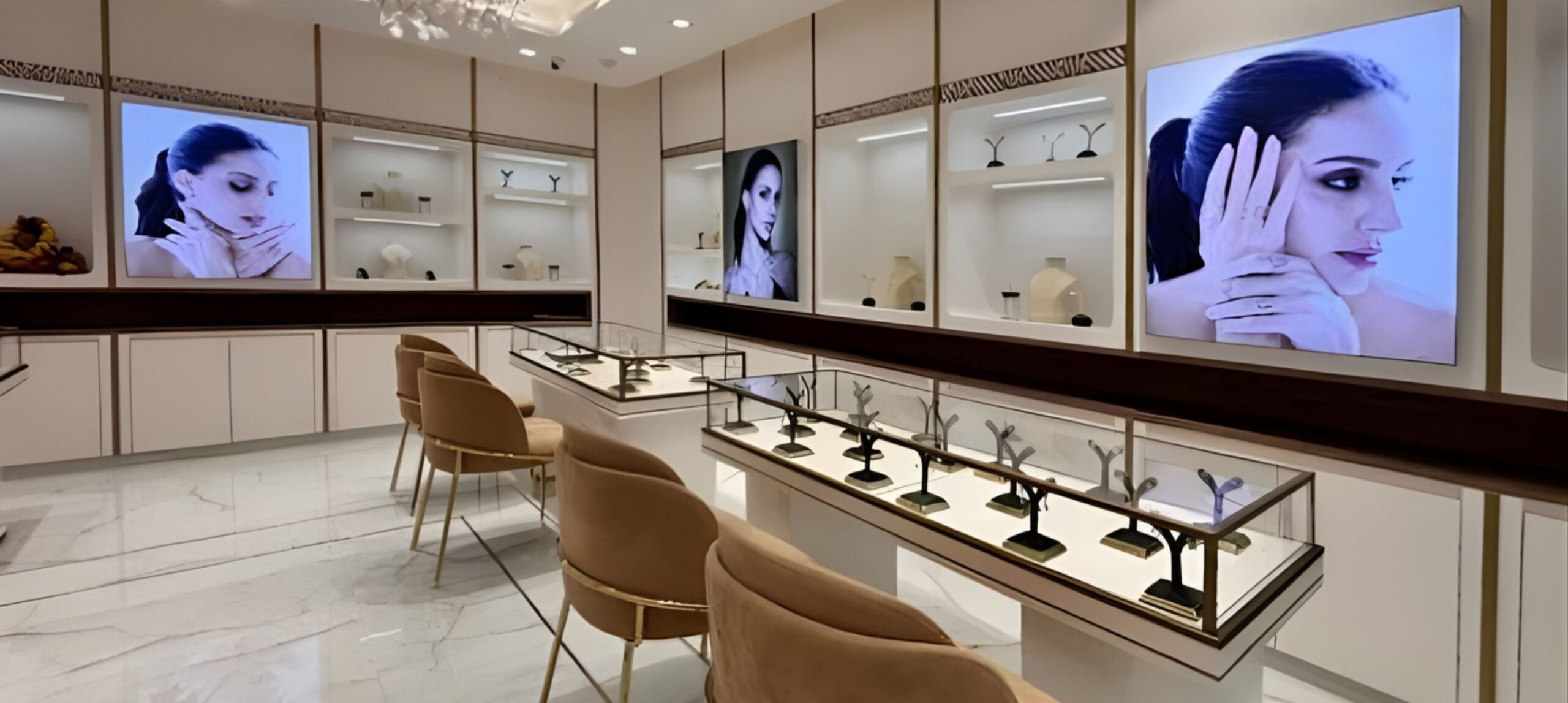
The floor plan of a diamond jewellery showroom is its first sales tool. Before a single piece of jewellery is placed, the layout is already communicating something to the customer about how the brand wants the transaction to unfold.
The entry sequence
Entry design in luxury jewellery store interiors is not about making a dramatic first impression. It is about giving the customer a moment of orientation before the merchandise begins. A short transition zone – even two or three metres – between the entrance and the first display counter lets the customer settle, adjust from the street, and arrive at the product with their attention intact.
Rushing the customer to the counter the instant they walk in creates a pressure dynamic that works against high-value purchases. The layout itself should communicate: take your time here.
Display counter placement
The most common layout mistake in Surat diamond showrooms is treating the floor plan as a grid to maximise display surface. Counter placement should follow customer movement logic, not square footage optimisation.
A few principles that hold across most showroom formats:
- Primary displays should be at natural pause points, not positioned to intercept traffic. A customer who stops voluntarily to look engages differently from one who is funnelled past a counter.
- Category sequencing matters. Moving a customer from accessible price points toward higher ones as they move deeper into the space is a layout decision, not a sales decision. The floor plan should be doing this work.
- Consultation zones need separation from browsing zones. When a customer sits down to examine a shortlist of pieces, they need a degree of spatial privacy. Open consultation in a high-traffic zone breaks the focus that leads to conversion.
Circulation width and customer comfort
Surat’s premium diamond showrooms often host multiple customers simultaneously. Corridor widths between counters need to allow for two people to stand at adjacent displays without encroaching on each other. That sounds basic. It is surprising how many floor plans get it wrong when the priority is fitting in more display units.
Display strategy: how the product is shown
Layout gets customers to the right place. Display strategy determines what happens when they get there.
Lighting for diamonds specifically
Diamond display lighting is not standard jewellery lighting. Diamonds respond to light differently from gold, coloured gemstones, or platinum. They require a light source that produces the spectral range needed to show brilliance and fire – typically a narrow-beam LED with a high colour rendering index and a colour temperature in the 3,000 to 4,000 Kelvin range.
Diamond showroom interior designers in Surat with category experience will specify display lighting as a design element from the outset, not as a procurement decision made after the casework is installed. The angle of the light relative to the stone, the distance, and the colour temperature all affect how a stone reads to a customer examining it for the first time.
Get this wrong and a two-lakh diamond looks like a one-lakh diamond. That is not a small commercial consequence.
Case design and viewing ergonomics
Display cases in diamond retail have to be designed around the act of looking, not the act of displaying. There is a difference.
A case designed for display is built to hold the maximum number of pieces attractively. A case designed for viewing is built around the angle at which a seated or standing customer can actually examine a stone without strain, glare, or awkward posture.
Practical considerations that matter here:
- Counter height should allow comfortable viewing for a seated customer during extended consultation, not just for someone standing and browsing.
- Glass specification affects perceived quality. Anti-reflective coated glass reduces the visual noise between the customer and the piece. Standard glass introduces reflections that distract from the stone itself.
- Tray and mount design should support the product, not compete with it. Overly ornate display mounts draw the eye away from the stone. Restraint in mounting design is a display decision, not a cost-cutting one.
The material and finish language of authority
Luxury jewellery store interiors in Surat are increasingly moving away from the high-gloss, maximalist aesthetic that dominated showroom design a decade ago. What is replacing it is a more restrained material language – one that communicates permanence and expertise rather than volume and display.
The specific direction this takes varies by brand positioning, but a few characteristics are consistent across well-performing showrooms:
- Stone and metal finishes over lacquer and veneer. Real materials age differently from surface treatments, and diamond customers in Surat have seen enough interiors to know the difference.
- Muted base palette with deliberate accent. A showroom with too much visual noise in its walls, floors, and ceiling forces the customer’s eye to work harder to arrive at the product. The interior should be receding, not competing.
- Craft details that reward proximity. A customer spending an hour in a showroom will look at the woodwork on the counter, the metalwork on the fixtures, the quality of the joinery. These details communicate something about how the brand treats its product. Sloppy finishing in a space selling precision-cut diamonds is a dissonance customers register even when they cannot name it.
What the brief for a Surat diamond showroom should contain
Before any design conversation begins, the operational brief needs to answer:
- What is the average transaction size, and what does the consultation process look like for that tier?
- How many customers does the showroom expect simultaneously at peak hours?
- Is the brand positioning primarily on product range, on certification and expertise, or on heritage?
- What is the balance between walk-in browsing and appointment-based consultation?
- Are there security integration requirements that affect display case design and layout?
Jewellery showroom interior designers in Surat who ask these questions before opening SketchUp are worth working with. Those who lead with aesthetics are designing for a pitch, not for a business.