Design That Pays Off: Measuring the Financial Impact of Hospitality Interior Renovations
The owner of the hotel works for several months remodeling the guest rooms, redoing the lobby, and updating the furniture. The property looks better, the guests like the changes and the management team is satisfied.
Now six months later, one question to be asked: Has the renovation really enhanced business performance?
If you are a hotel, restaurant, or other hospitality property, your interior renovations will be an investment in your business. So, when it comes to decisions about the hospitality architecture & interiors, you should think beyond aesthetics! The true consequence is whether the refurbished space contributes to revenue or lessens any operating challenges and enhances the guest experience.
The problem with the challenge is knowing what to measure.
A Beautiful Renovation Isn’t Always a Profitable One
If you think about two hotels that are spending a comparable sum on interior improvements, you’ll find that they both have comparable amounts to invest.
These are the first that are used to decorate the whole house. The latter deals with the awkward guest rooms, the underproductive reception desks and the restricted seating in the restaurant.
Either of them may be visibly different after renovation. The bottom line, however, may be quite different.
The distinction is between two investment goals.
Property owners should understand the issues that may exist with property and determine what business results they want to enhance before approving a renovation.
If you don’t have that point of origin, it’s hard to gauge success.
1. Start With Revenue Per Available Room
For hotels, Revenue Per Available Room (RevPAR) is one of the most useful performance indicators.
It measures room revenue against the total number of rooms available for sale.
RevPAR = Total Room Revenue ÷ Available Room Nights
Suppose a hotel has 50 rooms and records ₹30 lakh in room revenue over 30 days.
Its RevPAR would be approximately ₹2,000.
After renovation, management can compare RevPAR over equivalent periods to see whether performance has improved.
However, higher RevPAR cannot automatically be credited to the interiors. Seasonal demand, room pricing, marketing campaigns and local events may also influence revenue.
The comparison becomes more meaningful when these factors are considered.
2. Check Whether Guests Are Willing to Pay More
Renovated rooms may support stronger pricing when improvements genuinely matter to guests.
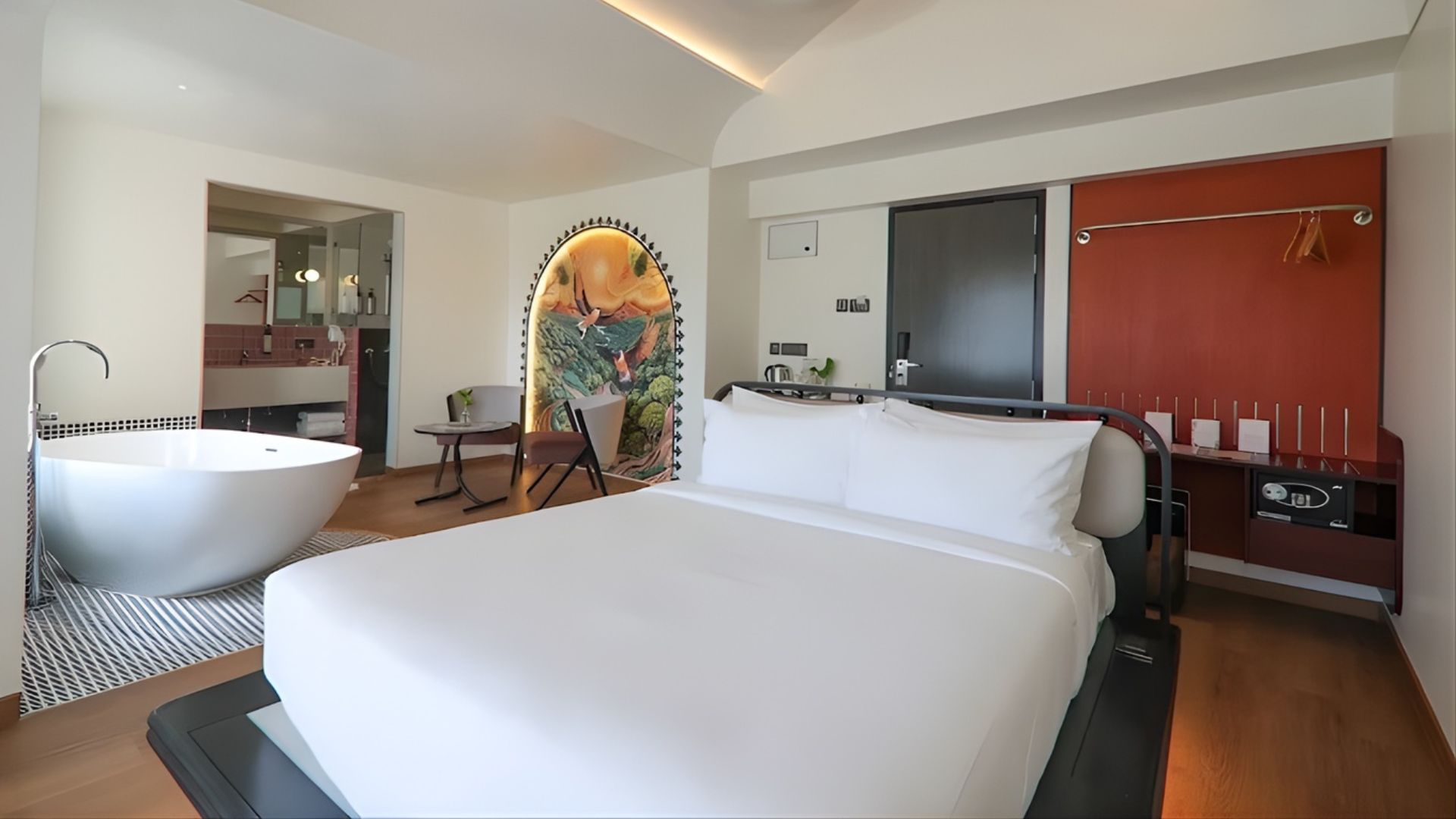
Better beds, practical lighting, comfortable furniture and well-planned bathrooms can improve the perceived quality of accommodation.
Average Daily Rate (ADR) helps measure changes in room pricing.
ADR = Room Revenue ÷ Rooms Sold
Compare the average rate before and after renovation, ideally across similar seasons and room categories.
A higher ADR is encouraging, but only when occupancy remains commercially healthy.
Charging more while losing a significant number of bookings may not produce the desired financial result.
3. Measure How Restaurant Layout Changes Affect Revenue
Hotel restaurants and standalone dining establishments need a different approach.
Here, the financial impact of hospitality architecture & interiors may be reflected in seating efficiency, customer movement and table utilisation.
For example, replacing oversized furniture with appropriately sized seating could improve circulation or create room for additional tables.
But adding seats isn’t always the right answer.
A crowded dining area can reduce comfort and make service difficult.
Useful indicators include:
- Revenue generated per available seat
- Average spending per customer
- Table turnover during busy periods
- Number of customers served per shift
These figures help determine whether the redesigned dining space is contributing to business performance.
4. Look at Operational Savings, Not Just Sales
Some renovation benefits appear in operating expenses rather than revenue.
A reception desk with adequate storage may reduce unnecessary staff movement. Durable furniture can lower replacement frequency. Better-planned housekeeping areas may make daily work easier.
The lighting and fixtures arrangement can impact the maintenance requirements.
When evaluating costs before and after a hotel renovation, hotel operators should look at the following factors:
- Repair and replacement of furniture.
- Cleaning and maintenance
- Electricity consumption
- Staff time involved in routine activities.
Any savings should be based on documented savings rather than assumptions on what the new design might be capable of.
5. Calculate the Return on Renovation Investment
After a successful renovation for a suitable length of time, owners should be able to consider the financial return of the renovation.
However, a simple calculation is:
Net Financial Gain = Financial benefits gained after the renovation minus the cost of the renovation
Assume that a property in hospitality invests ₹40 lakh in renovations and creates an additional net operating profit of ₹10 lakh in a year as a result of these investments.
The benefit to the annual return ratio would be 25%.
This is just a sample calculation. True assessment should take into consideration the time required for the renovation as well as and the extra operating costs incurred during the renovation and the time period for benefits to be calculated.
A renovation can also produce returns over a number of years, especially if the renovations include long lasting furnishings and long lasting interior components.
6. Don’t Ignore Guest Feedback
Financial statements provide information about what has occurred. Guest feedback can help to clarify why.
Once the renovation is complete, check the feedback on room comfort, lighting, furniture, accessibility and dining experiences.
If a similar problem occurs over and over again, then perhaps the problem is still there because they have made a costly mistake in the design.
Additionally, management can analyze if positive feedback corresponds with increased repeat bookings or customer satisfaction ratings.
Each is a good indicator of success and together they make for some useful context.
7. Compare Results Against the Original Renovation Goals
Any hotel refurbishment project needs to start with quantifiable goals.
For the purpose of room pricing, analyse ADR and RevPAR. If efficiency at the restaurant is the priority, study the utilisation of the seats and service performance.
In the case of hospitality architecture & interiors, this alignment of design choices with business objectives means owners can prevent themselves from wasting money on changes that could be less practically useful.
Not all improvements have to be money-making. Some investments can help maintain the property’s condition, enhance safety, or provide for long-term operating needs.
What is important is to compare them to the rationale for their approval.
Making Every Design Decision Count
A successful hospitality renovation is all about the balance between comfort, the need and financial prudence. Owners can develop a clear vision of their goal and have information that provides a reliable measure of performance to determine if they are on track to getting value from their investment.
We provide commercial interior design, design & build solutions and customised furniture and fixtures for all hospitality applications at Atmosphere. In Hospitality architecture & interiors, our design work empowers clients to design functional, well-thought-out spaces that align with their brand.