Bridal shopping in North Delhi is not a transaction. It is an event. The family arrives together, stays longer than they planned, revisits sections they already saw, and often makes the final call only after three conversations between four people with different opinions. Designing a store for this kind of shopper, without understanding her first, is where most ethnic fashion retail gets it wrong. The Kalki Fashion Design and Build in Pitampura started from a different place entirely.
Customer experience is not a layer on top of design; it is the design
There is a common mistake in how Indian fashion retail thinks about customer experience. It gets treated as a service question. Train the staff better, greet customers warmly, offer chai. All of that matters. But it sits downstream of a much more fundamental set of decisions, the ones made before the first fixture was installed.
How wide is the aisle? Where does the natural light fall? How far does a customer have to walk before she finds somewhere to sit? Is the fitting room easy to find or a small embarrassment in the corner? These are experience questions. They just happen to look like design questions on paper.
The Kalki Fashion Design and Build in Pitampura understood this from the start. The brief was not “build a luxury store.” It was “build a store where a family spending two to three hours feels attended to the entire time.” That is a different brief. And it produces different decisions.
Many of these principles are also explored in What Makes a Fashion Store Interior Attractive to Customers?, where we discuss how layout planning, lighting, materials, and customer flow come together to create a retail environment that encourages shoppers to stay longer and engage more comfortably with the space.
What 9,870 sq. ft. actually needs to do?
Scale sounds like an advantage. More space, more product, more room to breathe. In reality, large retail footprints are harder to manage experientially than smaller ones.
A customer who feels lost is a customer who leaves early. And in bridal retail, where the average purchase involves multiple return visits and long in-store sessions, losing someone’s confidence in the middle of the floor is a significant commercial problem.
The Pitampura showroom spans multiple floors. Here is what that demanded:
A ground floor that orients immediately
The first thirty seconds in any space set the entire emotional register for what follows. If the entry reads cluttered, overwhelming, or unclear, the customer is already on the defensive. The ground floor at Pitampura was designed to read open and calm before a word is exchanged with any staff member.
Floor transitions that feel purposeful, not effortful
In multi-level retail, the staircase is either a barrier or an invitation. Sightlines from the ground to the first floor, the quality of the landing space, the way light falls at the transition point, all of it either pulls the customer upward or gives her a reason to stop where she is.
The bridal floor as its own world
The topmost level carries the highest-value product. Spatially, it needed to feel earned, quieter, more intimate, more deliberately unhurried than the floors below it. The distance from the street-level buzz is part of the experience, not incidental to it.
Designing for the group, not just the individual
Most retail design is implicitly designed for one person. The aisles are sized for one person moving through. The fitting room is for one person. The staff interaction is one-to-one.
Bridal shopping does not work that way.
The customer at Kalki Pitampura typically arrives with her mother, often an aunt or a future mother-in-law, sometimes the groom. Everyone has an opinion. Everyone needs to feel comfortable. The experience has to work for the group as a unit, and that is a design problem as much as a hospitality one.
What that looks like in practice:
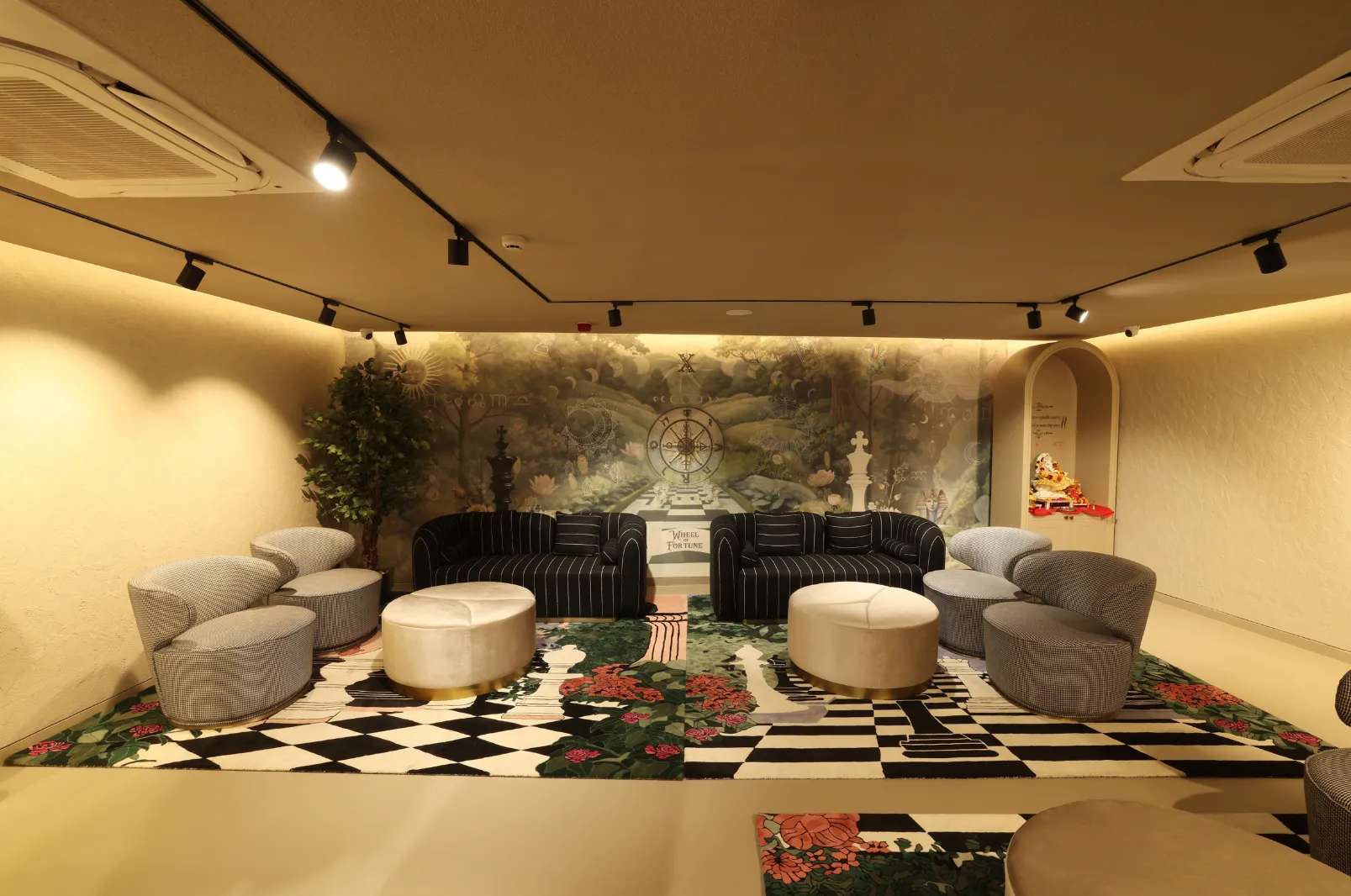
Seating that is part of the design, not an afterthought
In many Indian fashion stores, seating is a chair pushed against a wall. At Pitampura, the seating near display areas is positioned so that family members can observe what the primary shopper is considering without crowding her. That spatial distance, three feet, calibrated correctly, changes the dynamic of the conversation.
Trial areas that accommodate company
The zone immediately outside a fitting room is rarely designed. It is the gap between the display floor and the changing space. In a bridal context, that gap carries a lot of emotional weight, it is where the family waits, reacts, and discusses. Designing that space with the same intentionality as the display floor makes a material difference to how the session unfolds.
Display that invites side-by-side comparison
When a customer is choosing between two lehengas, she is not choosing alone. The display has to make it easy for two or three people to stand together and look at the same product from the same angle. This means fixture depth, lighting direction, and aisle width all need to account for a group, not a single viewer.
Lighting as a customer experience tool, not just an aesthetic one
Lighting in fashion retail is discussed mostly in terms of how it makes the space look. That is the wrong frame.
The correct frame is how it makes the product look, and more specifically, how it makes the product look on the customer’s body.
Garments look different under different light sources. Warm light flattens colour and adds richness. Cool light sharpens detail and makes whites appear crisper. Neutral light is safer but rarely flattering. In a bridal context, where the product is often heavily embellished, and the customer is comparing colours across a range, getting this wrong is a commercial decision, not just an aesthetic one.
The Kalki Fashion Design and Build in Pitampura treats lighting as a functional brief. The trial areas are lit differently from the display floor. The bridal collection upstairs sits under a warmer, more intimate light source than the occasion wear sections below. This is deliberate.
A customer who looks good under the light in the fitting room is a customer who is more confident in her decision. Confidence closes sales.
Why did Pitampura specifically require this thinking?
Every market in India has its own retail personality. Pitampura is a North Delhi wedding shopping destination where the customer is experienced, comparison-shops across multiple stores in the same visit, and brings high expectations to every retail interaction.
This is not a customer who is easily impressed by surface signals. A marble floor and gold fixtures are table stakes in this market. What she notices, and what she remembers, is whether the store made her feel like the visit was worth her time. Whether the layout made her shopping easier, not harder. Whether the space was designed with her actual behaviour in mind.
The Kalki Fashion Design and Build in Pitampura earns attention in this market because it was designed from the customer inward, not from the brand outward. The brand’s identity is present throughout the space. But it is expressed through how the store serves the customer, not just how it signals premium.
That is a meaningful distinction. And it is one that shows up clearly in how customers actually behave once they are inside.
Conclusion
The opening week of a new store is its easiest week. Footfall is driven by novelty, press, and word of mouth. The real test is months in, when the store is running on routine, when the staff has developed their own shortcuts through the space, when the customer is returning for a second or third visit.
Stores designed with genuine customer experience logic hold up under this test. The layout still makes sense when you know it well. The trial area is still comfortable at peak hours. The seating still works when the family has been there for ninety minutes.
The decisions made in the design of the Kalki Fashion Design and Build in Pitampura were made with this timeline in mind. Not just what works on a Tuesday afternoon in the first month, but what works on a Saturday in wedding season, when the store is full and every member of staff is occupied.
That is the level at which retail design either earns its investment or quietly starts to work against the brand it was meant to serve.
Atmosphere.work designs and builds retail environments for fashion, jewellery, and lifestyle brands across India. If you are planning a showroom where the customer experience has to be built in from the start, not added on top, that is the kind of brief we work best with.