Ask a shopper why she liked a store and she will usually say something vague. Nice atmosphere. Good energy. It just felt right. Press a little harder and the answers do not get much more specific. People experience retail environments before they analyse them. The body responds before the mind catches up. What that means for designers is both a challenge and a very useful insight, and the kalki fashion design and build in Chattarpur is one of the cleaner illustrations of how to use it.
Attraction is not about appearance
The instinct in fashion retail is to lead with aesthetics. Beautiful finishes. Impressive facades. A logo wall that reads well on Instagram. None of this is wrong exactly, but none of it is what actually draws a customer in and keeps her there.
Attraction in retail is a sensory and spatial experience. It is what happens in the first eight seconds after someone crosses the threshold. It is the air temperature, the ceiling height, the sound level, the direction of the light, the distance between the first display and the door. Each of these signals something. Together, they tell the customer whether this space is for her or not.
Most fashion retailers design for the camera first and the customer second. The result is stores that look exceptional in press photographs and feel slightly hollow in person. The hollowness is hard to name but immediately felt.
The Chattarpur context changes the stakes
Chhattarpur in South Delhi is not a regular retail corridor. It has emerged as one of the most competitive bridal and luxury fashion destinations in the capital, and that designation comes from customer behaviour, not a marketing campaign. Shoppers in this area are comparison-shopping across multiple stores in a single afternoon. They know what considered design feels like. They have been in enough good spaces to notice when something is off.
Designing a fashion store that is genuinely attractive in this market, not just visually striking, but felt as right, is a more demanding problem than it sounds.
The same customer-first design philosophy can also be seen in How the Kalki Pitampura Showroom Was Designed for Better Customer Experience, where thoughtful layouts, carefully planned customer flow, and well-designed retail spaces create a more comfortable and engaging shopping journey. While each showroom has its own identity, the underlying goal remains the same: designing spaces that put the customer experience first.
The six things that actually make a fashion interior attractive
The kalki fashion design and build in Chattarpur works as a case study here because it gets each of these right, and it is instructive to look at why.
1. The arrival experience sets every expectation that follows
A fashion store’s entry is not a hallway. It is the first sentence of a story the brand is telling. A cramped, over-lit, product-heavy entry says: this is a place to buy things. A calm, proportioned, unhurried entry says: this is a place to spend time.
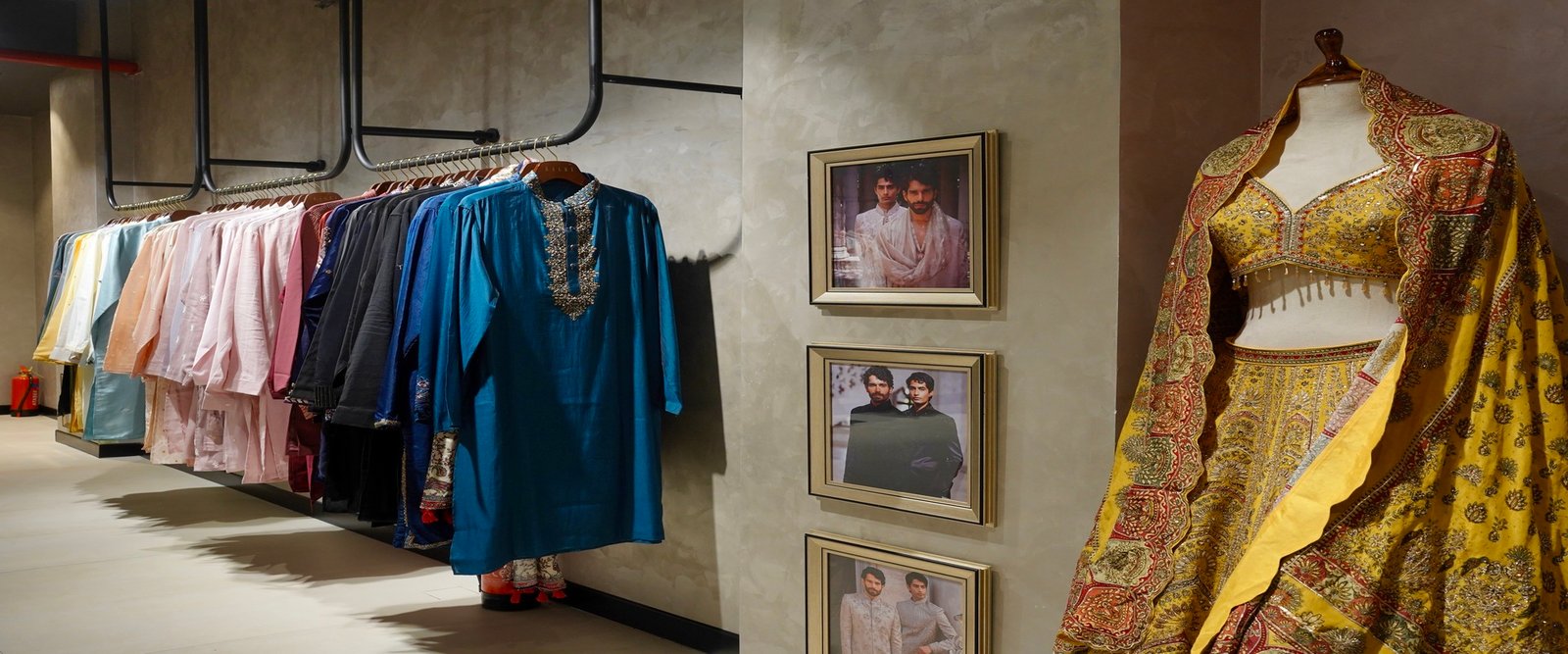
Chattarpur opens with something closer to a lobby than a showroom floor. The ceiling drops slightly from the street, the palette cools, the pace changes. A customer who was moving through a busy market thirty seconds ago arrives somewhere that asks her to slow down. That tonal shift is a design decision, not a decorating choice.
2. Breathing room around product signals confidence
There is a direct relationship between how a brand displays its product and how that product is perceived. Crowded displays communicate urgency and volume. Sparse, generous displays communicate value and deliberateness.
In the Chattarpur store, the garments have room. The eye can travel across a collection without encountering visual noise. In bridal and occasion-wear fashion, where a customer is often choosing between pieces that vary subtly in embroidery detail, colour temperature, and silhouette, this matters enormously. You cannot evaluate a lehenga when it is flanked on both sides by two others that are visually competing with it.
3. Texture and material language do quiet work
Customers touch things in fashion stores. Not necessarily the product, often the walls, the counter edge, the chair arm, the door handle. These are the surfaces that communicate quality at the skin level, bypassing the eye entirely.
The material choices at Chattarpur, the textured surfaces, the warmth of the wood, the quality of the joinery, are not decorative decisions. They are tactile signals. A customer who has touched three or four surfaces that feel considered before she has looked at a single garment is already in a different relationship with the brand than one who has not.
4. Lighting that flatters the product and the person
Fashion retail lighting is discussed more than almost any other design element. Most of that discussion focuses on highlighting products. That is important. But the more commercially significant question is how the lighting makes the customer look.
A woman trying on a lehenga in a fitting room lit with cold, overhead fluorescent light sees a version of herself that is less flattering than the reality. A fitting room lit with warm, slightly directional light from multiple sources sees a version that is more accurate, more generous, and more confidence-building. That confidence is what closes the sale.
The kalki fashion design and build in Chattarpur treats trial room lighting as a brief in its own right. Not an afterthought tucked into a corner, but a specific and considered design decision.
5. Private space signals premium
There is something that happens when a customer is given a private space. The purchase becomes more considered. The conversation with the sales staff becomes more candid. The family members who are along for the visit relax into the experience rather than hovering at the edge of it.
Luxury in fashion retail is increasingly defined not by the richness of the materials but by the availability of privacy. This is a significant shift from even five years ago, when open browsing floors were considered the gold standard for premium retail. The Chattarpur store offers dedicated family-focused modules, contained zones with seating, trial rooms, and personal assistance built in, that shift the entire experience from transactional to consultative.
6. Scale that serves the customer, not the brand’s ego
Nearly 12,000 square feet is an impressive number. It is also a spatial problem. Large retail environments can feel institutional, disorientating, or exhausting. The customer who enters a store this size without clear spatial cues will reduce her own dwell time simply to manage the cognitive load.
The Chattarpur store follows its scale. The customer does not encounter 12,000 square feet all at once. She encounters it as a series of smaller, legible environments, each with its own character, its own product focus, its own pace. The cumulative experience is generous and considered. The individual moments are intimate.
What the Chhattarpur market tells us about the future of fashion retail in India
Something is changing in how Indian customers relate to luxury fashion retail. The customer who walks into the kalki fashion design and build in Chattarpur is not just shopping. She is curating an experience that she will remember and describe to other people, including the people whose opinion she trusts most when it comes to bridal decisions.
Word of mouth in this category is not about what she bought. It is about how the store made her feel. Whether it respected her time. Whether the space acknowledged that this is not a casual purchase. Whether the entire visit felt like it was designed for her, rather than designed to move product.
Stores that answer yes to all of those questions create customers who return. And in bridal fashion, where a single customer can drive five or six purchase decisions across a family over a two to three year period, that kind of loyalty is commercially significant in ways that are hard to overstate.
Design is how you answer those questions without saying a word.
Atmosphere.work builds retail, hospitality, and workspace environments for brands that take the physical experience seriously, from the first floor plan through to the final fitting. If you are planning a flagship or a significant store refit, the brief starts with understanding your customer first.