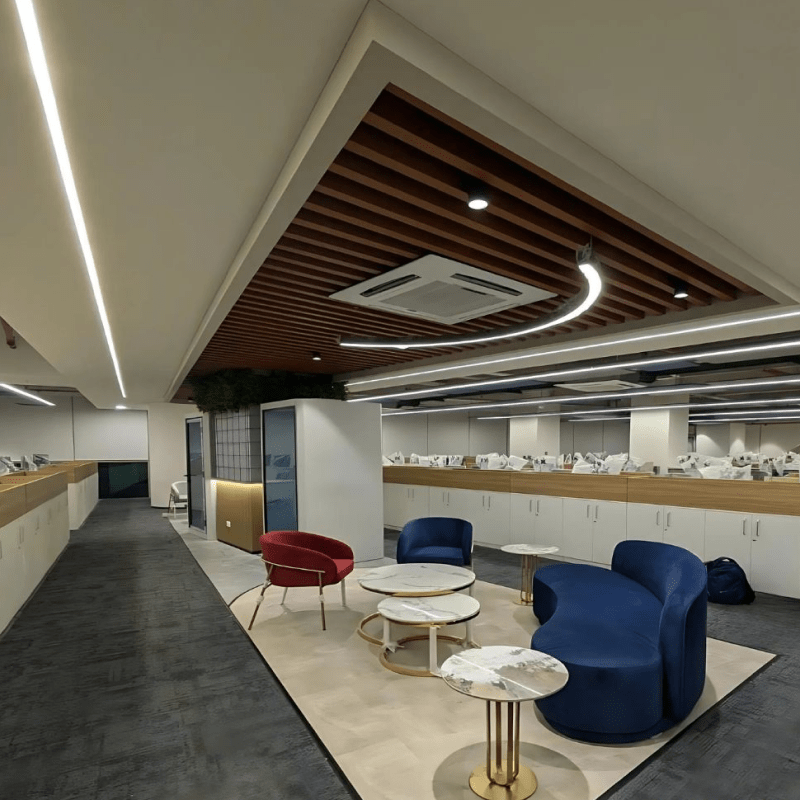
Ask a Bangalore company why they need a new office and the answer is rarely “the old one was ugly.”
It is usually something more specific. The team doubled and the space stopped working. The hybrid model created a floor plan built for a reality that no longer exists. Three departments that need to collaborate constantly are separated by a partition wall from 2019. The office that made sense when they were a fifty-person startup now actively works against how a three-hundred-person company needs to operate.
The brief for a modern workspace is, at its core, an organisational problem dressed up as an interior one. And the office interior designers in Bangalore who understand that distinction – who read the operational reality before they open a drawing – produce work that actually moves the needle for the businesses that commission them.
This guide is for growing companies, HR and real estate leads, and founders in Bangalore who are about to take on an office project. It covers what modern workspace design actually involves, where the common decisions go wrong, and how to find a firm that can execute the whole thing without fragmenting into a coordination nightmare.
The office has a new job description
The old office was a container. You put people in it, gave them desks, and work happened. The measure of success was whether it held everyone comfortably and looked professional enough for a client visit.
That job description is obsolete.
Bangalore’s talent market is competitive in a way that changes what the office has to do. For companies running hybrid models, the question is no longer whether people have a place to work – they have that at home. The question is whether the office is worth the commute. Whether it offers something the home desk cannot: the right energy, the right collaboration infrastructure, the right kind of focus for work that benefits from proximity to other people.
A workspace that fails this test does not empty dramatically. It empties slowly, over months, as the default keeps shifting toward home until the office becomes a cost centre with no corresponding output. That is a design failure with a financial consequence, and it shows up in occupancy data long before it shows up in any other metric.
What modern workspace design is actually solving for
Before any floor plan is drawn, the brief needs to be honest about a few things.
How does the company actually work today – not how it is supposed to work, but how it demonstrably does? Where do informal collaborations happen? Which teams generate most of their value through proximity and which ones are genuinely heads-down independent? What does a Tuesday at 11am look like in terms of floor occupancy and what people are doing?
These questions produce a spatial brief that reflects reality. Without them, the design reflects aspiration – which often means an office that looks excellent in a presentation and performs modestly in daily use.
The specific design problems that come up most consistently in Bangalore’s growing company segment:
- Collaboration infrastructure that does not scale. A single large meeting room and a scattering of phone booths works for thirty people. It breaks down at eighty. The ratio of collaboration space to individual work space needs to be calibrated to the actual meeting culture of the organisation.
- Focus work environments that have been designed out. An open plan has genuine benefits. It also produces environments where sustained concentration is genuinely difficult, and the companies that have removed all enclosed or semi-enclosed work areas have often done so at a cost to the output that requires deep focus.
- Acoustics treated as a finishing decision. Noise is the most cited reason employees in Bangalore’s open offices choose to work from home. It is also almost entirely solvable at the design stage and significantly more expensive to address after the fit-out is complete.
- Brand identity that ends at the reception desk. The entrance looks considered. The rest of the office looks generic. This is a brief problem, not a budget problem – the brand environment should run through the entire space, not just the front forty square feet.
The case for end-to-end interior design services
This is where most Bangalore office projects make their first structural error.
The instinct is to keep things separated: appoint a design firm, then appoint a contractor, manage the relationship between them, and step in when there is a disagreement. This feels like control. In practice, it produces fragmentation – and fragmented accountability is the primary reason office projects in Bangalore run over timeline and over budget.
End-to-end interior design services solve this by making one firm responsible for the full chain: design, manufacturing where custom elements are involved, procurement, civil coordination, and site execution. One brief, one contract, one point of accountability from the day the scope is agreed to the day the keys are handed over.
The commercial benefit in Bangalore’s market specifically is significant. The city’s office lease structures often tie fit-out completion to rent-free periods. Missing the handover date does not just mean a delayed opening – it means paying rent on a space that is not yet operational. For a three-hundred-seat office, that cost compounds fast.
Interior turnkey projects managed by a single firm with real manufacturing and execution capability compress this risk. Design decisions are made with manufacturing reality in front of them. Lead times are known because the same organisation making the design is making the product. Site sequencing is managed by a team that designed the space, not by a contractor interpreting someone else’s drawings.
How to evaluate office interior designers in Bangalore
The selection process for an office fit-out should not begin with a design presentation. It should begin with a delivery conversation.
Questions that reveal more than a portfolio:
- What were the last three projects you delivered, what was the committed timeline, and what was the actual one? The gap between those numbers is the most honest metric in the industry.
- Do you have in-house manufacturing for custom elements, or do you coordinate with external vendors? The answer determines how much of the project accountability actually sits with the firm.
- Who is the project manager on our account and are they available during site execution? The person who runs the pitch and the person who runs the site are often different in firms that oversell and understaff delivery.
- How do you handle a design change that comes after construction has started? This happens on every project. The process for handling it reveals the firm’s actual capability.
- Can we speak to a client who is twelve months past handover? Not six weeks after opening when everything is still new. Twelve months in, when the space has had time to perform.
Office interior designers in Bangalore who field these questions with specifics, with real numbers, and with genuine references are a different category from those who redirect to case studies and mood boards.
The workspace brief: what to get right before anyone else is in the room
The single most valuable investment before engaging a design firm is a week spent answering these questions honestly:
- What is the headcount now, and what is the realistic eighteen-month projection?
- What percentage of the team is in the office on a given day, and does that vary significantly by day of the week?
- What types of work happen in the office that genuinely benefit from the physical environment?
- What is the one thing about the current office that most consistently generates friction or complaint?
- What does a successful office look like for this business in two years, not on opening day?
A brief built on these answers gives a design firm something real to solve. It also gives you a benchmark to evaluate proposals against – because proposals that do not respond to these specifics are responding to a generic brief that anyone could have sent.
Interior turnkey projects that deliver well start here. Not with a site visit and a square-footage estimate. With an honest conversation about what the business actually needs from its physical environment and what it is currently not getting.