Nobody tells you how disorienting an empty shell unit feels the first time you stand in it.
You have signed the lease. You have the product. You have a brand name and a logo and maybe a soft launch date in your head.
Then you walk into the unit in Lajpat Nagar or Saket or Kamla Nagar, and you are looking at bare concrete, a single tube light hanging from the ceiling, and raw walls that go back further than you expected. The gap between this room and the store you imagined is not just visual. It is psychological.
Getting from that moment to a functioning store that actually performs is the problem this piece is about. And this is where pro retail interior designers in Delhi come in!
The Sequence Problem Nobody Warns You About
Most first-time retail founders in Delhi make the same structural mistake. They treat the store build as something that happens after the other decisions. Product is sorted first. Staff is sorted. The social media page is up. Then, a few weeks before the intended opening date, someone contacts a contractor.
This is backwards. And it is expensive.
A retail build has a critical path. Electrical work cannot start before the lighting plan is finalised. The lighting plan cannot be finalised before the fixture layout is resolved. The fixture layout cannot be resolved without knowing how the product is going to be displayed. All of these decisions connect, and if you start at the wrong end of the chain, you pay to redo things that were already done.
Retail interior designers in Delhi who work on commercial builds regularly know this sequence. Most first-time owners don’t. The result is a build that takes twice as long as planned, costs 30 to 40 percent more than budgeted, and opens with compromises baked into the space from day one.
The fix is not complicated. It is just a different order of operations.
Start with the Customer Journey, Not the Floor Plan
Before any sketch, any contractor call, any fixture catalogue: map what a customer does from the moment they walk in.
Where do their eyes go first? What is the thing you want them to see before they see anything else? Where do they slow down? Where do they make the decision to pick something up? Where does the transaction happen, and what does that moment feel like?
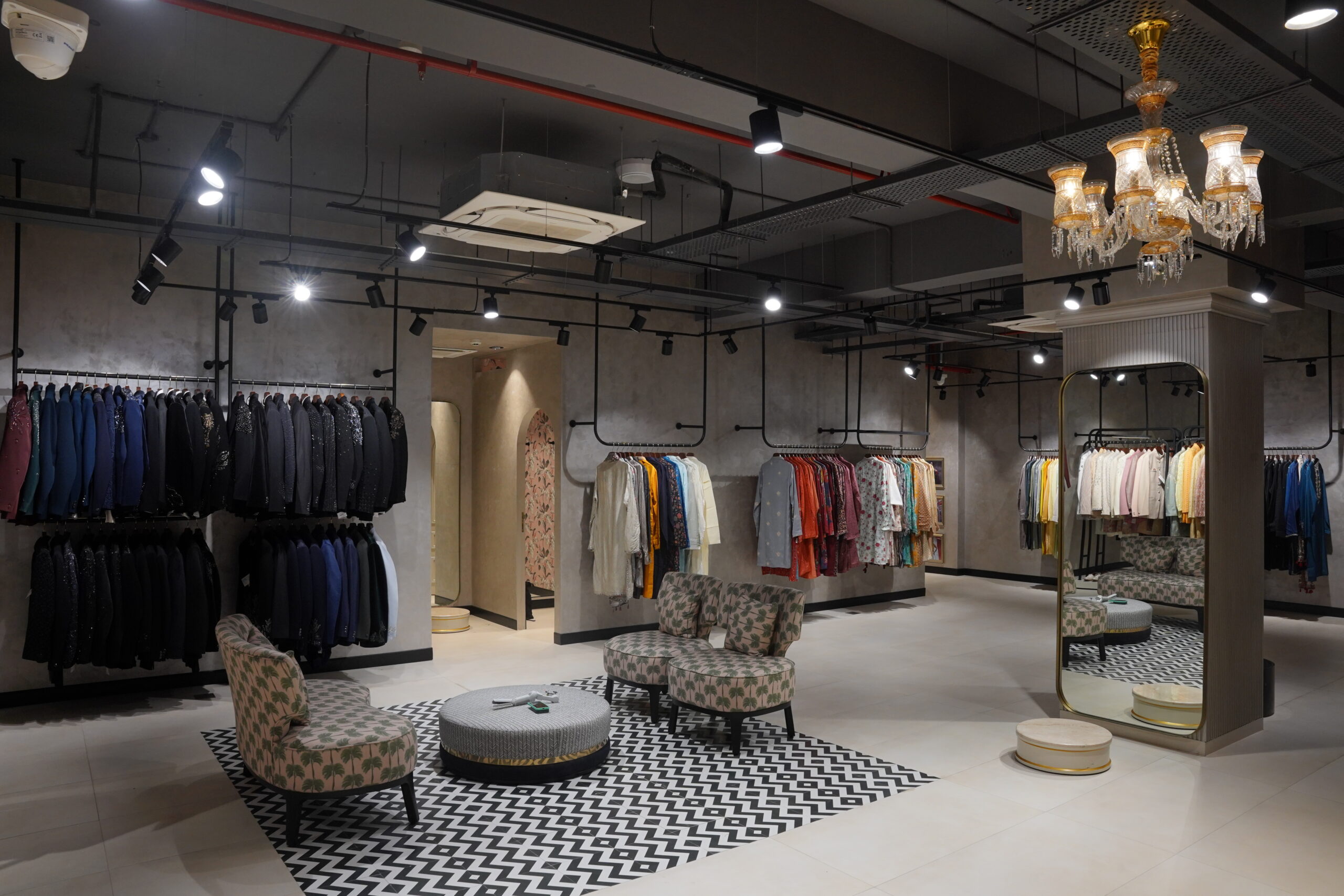
This is not abstract. Every one of these questions has a spatial answer. The eye goes to the focal point at the back of the store if the entry has no interruption. Customers slow down at mid-height fixtures at the 45-degree angle from the door. They pick things up when the display is at elbow height, not eye height. The transaction moment at the counter needs to feel like a conclusion, not an interruption.
A store that is designed from the customer journey outward performs better than one designed from the floor plan inward. This sounds obvious. Very few stores are actually built this way.
The Four Decisions That Set Everything Else
Once the customer journey is mapped, four decisions cascade from it. Get these right and the rest of the build follows logically. Get them wrong and you are making corrections for years.
1. Zoning
Which products live where, and why. A store where the high-margin items are buried at the back is a store that underperforms. A store where the entry zone has too much product density is one where customers feel overwhelmed before they have committed to being there.
2. Fixture specification
Not the brand of fixture. The height, the material, the footprint, the spacing. A fixture that is 10 centimetres too tall changes the sightline across the entire floor. A material that looks right in a catalogue photograph looks different under your specific lighting at your specific ceiling height.
3. Lighting design
Retail lighting is not the same as office lighting or residential lighting. It has to make your specific product look like its best version of itself. A fabric store needs a different colour temperature than a cosmetics store. An electronics retailer needs a different intensity distribution than a shoe store. Getting this wrong does not produce a dramatic failure. It produces a space where the product never quite looks the way it does in the brand’s own content, and nobody can articulate why.
4. The counter
Where it sits, how it faces, what it communicates. A counter at the centre of the floor stops traffic. A counter at the side creates flow. A counter at the back creates discovery. Each placement is a different commercial decision, not just a spatial one.
What Delhi Specifically Does to a Retail Build
Delhi is not a forgiving retail market. It has high lease costs, high customer expectations, and very short patience for a store that feels unfinished.
The city also has extreme seasonal variation. A store that handles summer foot traffic differently from monsoon and winter traffic is a store with a serious flow problem. Air conditioning placement, entry matting, the relationship between the entrance and the first fixture: these are not decorative decisions in Delhi. They are operational ones.
Retail interior designers in Delhi who have built across markets like Connaught Place, Rajouri Garden, South Extension, and Khan Market understand these pressures as lived experience. A designer who knows the market knows that a glass-fronted entry in South Delhi behaves differently in May than it does in January, and designs for both.
This is not knowledge you find in a brief. It comes from having built stores in this city across categories and seen what holds and what does not.
The Grand Opening Is a Deadline, Not a Goal
Here is something that takes most founders by surprise: the grand opening is not the finish line. It is a deadline that reveals whether the build process was disciplined or not.
A store that opens three weeks late opens into a market that has already moved on. The social media buzz has dissipated. The press moment has passed. The staff who were hired for the opening have been waiting idle. The owner is exhausted and the space has compromises they are already mentally listing.
A store that opens on the date it said it would, in the condition it was designed to be in, with a team that has had time to learn the space before customers arrive: that store has a different first month. And the first month sets the rhythm for everything that follows.
The build process is what determines which of these two stores you end up with. Not the product. Not the branding. The build.
How Atmosphere Approaches This
Most Delhi retail builds are fragmented by default. One contractor for civil work, another for electrical, a separate furniture vendor, a lighting consultant who sees the project once. Nobody is accountable for the outcome. Everyone is accountable for their piece.
Atmosphere builds retail stores as a single integrated process. Design, prototyping, manufacturing of custom fixtures, and fit-out sit inside the same organisation. When the design changes, the manufacturing team already knows. When the fixture spec needs to shift to meet a timeline, it happens within the same building, not across four supplier relationships.
For a first-time retail founder in Delhi navigating the gap between a signed lease and a grand opening, that integration is not a convenience. It is what makes the timeline real and the outcome predictable.
Retail interior designers in Delhi who also manufacture and build remove the single biggest failure point in a commercial fit-out: the gap between what was designed and what was delivered.
If you are standing in an empty shell unit right now, or signing a lease in the next thirty days, the conversation worth starting is not about aesthetics. It is about who holds the whole process from that bare concrete floor to opening day.