North Delhi has its own rhythm when it comes to wedding shopping. Pitampura is not a market that rewards subtlety on the outside, but the customer walking in already knows what she wants. She is not browsing. She is deciding. That is a very specific kind of person to design a store for, and it is exactly the challenge that made the Kalki fashion design and build in Pitampura one of our more considered projects.
9,870 sq. ft. across multiple floors. Bridal couture, occasion wear, menswear, accessories, all needing space, all needing their own distinct moment within a single cohesive environment.
Here is what the design had to actually solve.
The Customer Journey Problem In Multi-Floor Retail
Single-floor stores are relatively forgiving. The eye travels, the customer drifts, the layout does most of the work.
Multi-floor retail is harder. Every staircase is a decision point. Every level needs to earn the customer’s effort to go up there. If the ground floor does not set the right tone, the bridal floor two levels up never gets footfall, regardless of how beautiful it is.
The Pitampura store stacked three distinct retail zones across floors, with the bridal collection occupying its own dedicated level at the top. That is not an accident of floor planning. It is a deliberate design decision that treats the bridal zone as a destination within the destination.
Getting customers there requires:
- A ground floor entry that reads luxury immediately the first 30 seconds after a customer walks in sets her expectation for the entire visit
- Visual cues that pull upward sightlines, lighting, and spatial breaks that make the next floor feel like a continuation, not a climb
- Zoning that respects the product hierarchy occasion wear and sarees as the accessible entry point, bridal as the considered, intimate experience at the top
The Kalki fashion design and build in Pitampura was structured around this logic from the first floor plan.
What “Luxury” Actually Means In A North Delhi Bridal Context
It does not mean cold. It does not mean stark.
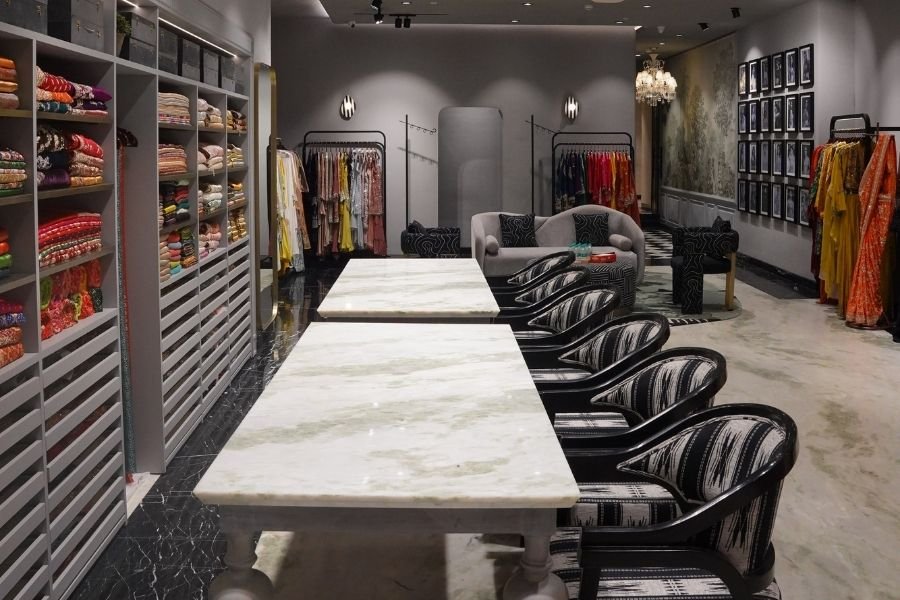
The Pitampura customer is often shopping with her mother, her mother-in-law, and sometimes the groom. It is a family purchase. The space needs to accommodate multiple people with different opinions, different comfort levels, different ideas about what feels right, all at the same time.
That changes the design brief considerably. A few things that mattered here:
- Seating that invites lingering: Not just a chair in the corner, but plush, positioned seating that makes family members feel included in the experience rather than waiting it out
- Display density that feels curated, not crowded: Wedding collections need breathing room; the eye needs pauses
- Fitting areas that feel private: The trial experience in bridal retail is sensitive; the spatial design around it has to reflect that
Warm finishes, soft lighting calibrated to how garments actually look on the body, clear sightlines between sections without everything bleeding into everything else. These are the decisions that make the difference in a space like this.
Design Consistency Across A Multi-City Rollout
The Pitampura store is part of a larger story. Atmosphere has partnered with Kalki Fashion across Delhi Southex, Ahmedabad, Bengaluru, Surat, and Hyderabad, each project a design and build under one roof, each store designed by Sheena.
That multi-city context matters. Consistency of brand experience across locations is one of the harder things to achieve in retail rollouts. The challenge is not repeating the same store. It is carrying the same brand language into spaces that differ in size, shape, location, and customer profile.
The Kalki fashion design and build in Pitampura sits within that broader design system, but it reads as a North Delhi store. The scale, the spatial generosity in the bridal zone, the attention to family-oriented retail comfort, these reflect where it is and who it is for.
That balance between brand consistency and local relevance is something you have to build for deliberately. It does not happen by applying the same template city to city.
What Other Indian Fashion Brands Can Read Into This
Pitampura is an interesting case study because the brand was entering a market that already has strong existing players in bridal and occasion wear. The store had to work harder than a generic luxury retail space.
A few principles that carry beyond this project:
- Floor planning is brand strategy: Where you put your hero product, how you make the customer travel to get there, these decisions shape how the brand is perceived, not just how the store functions.
- Multi-floor retail needs a vertical narrative: Each level should feel like a chapter, not a repetition.
- Family retail is its own design language: If your customer rarely shops alone, design for the group, not just the individual.
The result in Pitampura is a store that handles 9,870 sq. ft. without feeling like it needs to shout about it. The Kalki fashion design and build in Pitampura lands where the best bridal retail spaces are, considered, unhurried, and clearly built for the person making one of the most important purchases of her life.
At Atmosphere, we work with Indian fashion and retail brands to build spaces that carry the weight of what the brand stands for, from first floor plan to final fit-out. If you are planning a multi-city rollout or your next flagship, we would be glad to be part of the conversation.
FAQs
1. What makes the Kalki Fashion Pitampura store unique from other fashion retail stores?
The Kalki Fashion Pitampura store is designed across multiple floors with dedicated zones for bridal wear, occasion wear, menswear, and accessories. The layout creates a seamless customer journey while maintaining a luxurious and comfortable shopping experience.
2. Why is customer journey planning important in multi-floor retail design?
Customer journey planning ensures that every floor feels connected and purposeful. Strategic zoning, visual cues, and thoughtful layouts encourage visitors to explore different levels while enhancing engagement with the brand and its collections.
3. How does retail design influence bridal shopping experiences?
Bridal shopping often involves family members and longer decision-making processes. Features such as comfortable seating, private fitting rooms, spacious displays, and warm lighting help create a relaxed environment that supports a premium shopping experience.
4. How can brands maintain consistency across multiple store locations?
Brands can maintain consistency by developing a strong design language that reflects their identity while adapting each store to its local market, customer preferences, and spatial requirements. This creates familiarity without making every location feel identical.
5. What should fashion brands consider when planning a multi-floor flagship store?
Fashion brands should focus on product hierarchy, customer flow, floor zoning, visual continuity, and overall brand storytelling. Each floor should serve a distinct purpose while contributing to a cohesive retail experience that encourages customers to explore the entire store.