Airport retail does not give you a second chance to make a first impression. It does not even give you a complete first impression. It gives you a fraction of one.
The customer walking through Bengaluru International Airport is in motion. Her attention is split between a boarding gate, a phone screen, and whatever her peripheral vision catches as she passes. The window for a retail store to register – genuinely register, not just be seen – is measured in seconds. After that, she is gone.
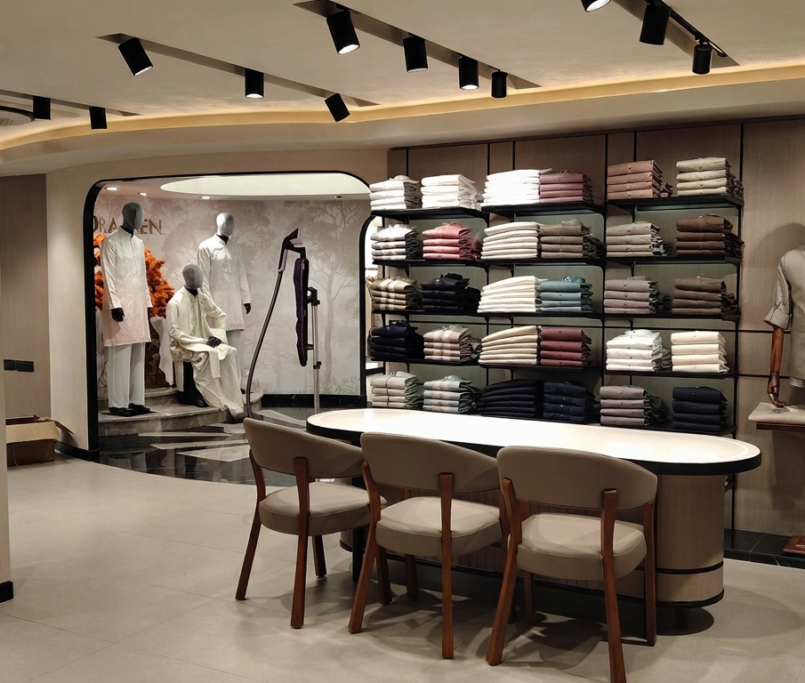
This is the operating reality behind Perona fixtures & furniture in Bangalore. A 2,000 sq. ft. apparel store at one of India’s busiest airports, built to convert a walking-past glance into a stop, and a stop into a sale. What makes this project worth examining is not the format – airport retail is familiar – but the specific discipline that fixture and furniture design demands when the customer’s time and attention are the hardest constraints in the brief.
When The Fixture Is The Display Strategy
In most retail environments, a brand has the luxury of context. The customer has made the decision to visit. She has time. The store can unfold around her gradually, leading her through zones and collections at a pace the layout controls.
Airport retail removes that luxury completely.
In a transit environment, the fixture is not just where the product sits. It is the first communication the brand makes. The height of the rail, the angle of the shelf, the density of product on display, the sightline from the corridor into the store – all of it is read in the first two seconds by a customer who has not slowed down yet.
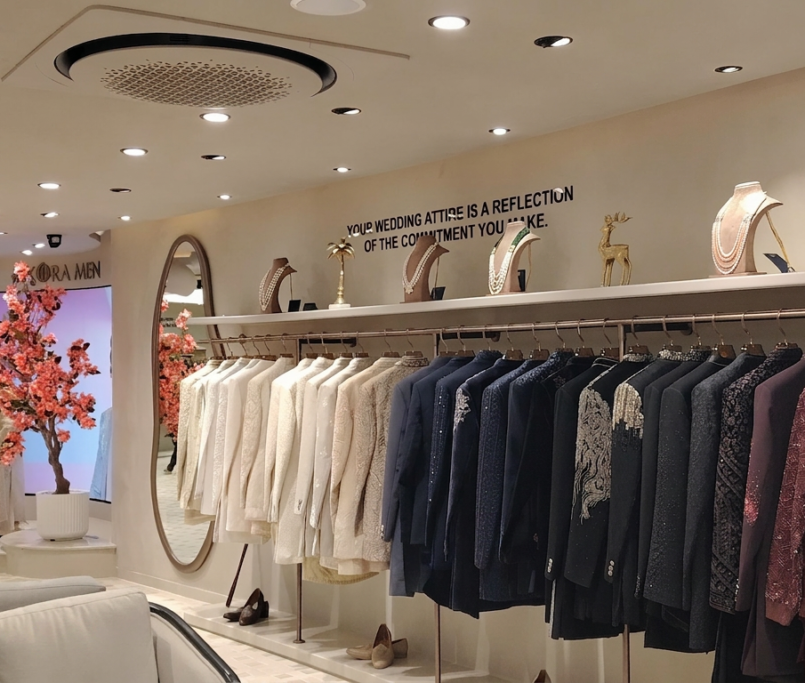
For Perona fixtures & furniture in Bangalore, fixtures were manufactured with one primary objective: guide visibility and accessibility simultaneously. This means a customer glancing from outside the store can understand what the brand offers and where to find it – without needing to enter first and orient herself. The decision to enter is made at the threshold, not inside.
That is a different design problem to a standard retail fixture brief. And it requires a different manufacturing precision in response.
What “Clean And Consistent” Actually Means In Practice
Every retail brief mentions clean design and consistent materiality. Few projects actually achieve both.
Here is why the gap exists. Clean material language requires discipline at the specification stage – choosing fewer materials and committing to them fully. Consistency requires manufacturing control that holds those specifications across every single piece, from the first unit to the last. In practice, both are easier to promise than to deliver.
The Perona fixture & furniture in Bangalore scope held these standards across 2,000 sq. ft. in a format where the consequences of inconsistency are immediate. In a conventional store, a single fixture that reads slightly off can be repositioned or masked. In an airport environment where the store is essentially a display window to a corridor, there is nowhere to hide an underspecified piece.
What this requires from a manufacturing standpoint:
- Identical finish quality across all units: The first fixture and the last one off the production line have to be indistinguishable in finish, surface quality, and hardware behaviour
- Dimensional precision that works with the site: Airport retail spaces have structural constraints that are less forgiving than mall formats; fixture dimensions have to be specified against the actual site conditions, not theoretical measurements
- Materials chosen for the airport operating environment: High-footfall,
- temperature-controlled, constant artificial lighting; these conditions affect how materials behave over time in ways that matter for a brand whose store is open every single day of the year
The Brand Coherence Problem In Transit Retail
Perona as a brand has a clear visual identity. Translating that into a transit-driven format is not a shrinking exercise – taking the full store and making it smaller. It is a reduction exercise – identifying which elements of the brand identity carry the most weight at first glance and building the fixture and furniture scope around those.
A full apparel store might use five or six design moves to communicate the brand. An airport store has space, attention, and time to use two or three. Choosing the right two or three – and executing them at the quality level the brand demands – is where Perona fixture & furniture in Bangalore does its real work.
The result is a store that reads as a Perona environment within seconds of approach. That is the measure of whether a transit retail fitout has succeeded. Not whether it looks good in isolation, but whether it communicates the brand fast enough to catch a customer who is already moving.
What Apparel Brands Expanding Into Airports Need To Think About
Bengaluru airport is a serious retail market. The traveller base skews urban, professional, and internationally travelled – a customer with a refined eye for retail environments and no obligation to stop anywhere.
For apparel brands considering airport formats, a few things this project surfaces:
- The fixture brief and the display strategy have to be developed together – treating them as separate decisions produces environments where one undoes the other
- Manufacturing quality matters more in transit formats than in conventional stores, not less – there are fewer design elements to compensate for an underspecified piece
- The 2,000 sq. ft. constraint is an editorial decision, not a limitation – it forces clarity about what the brand actually needs to communicate at first contact
At Atmosphere, we manufacture custom fixtures and furniture for retail brands, commercial spaces, and hospitality environments across India – from in-house production at our facility to on-site installation. If you are planning a retail rollout, an airport format, or a commercial interior that needs fixtures built to the brief rather than close to it, we would be glad to start that conversation.
FAQs
1. Why are fixtures and furniture important in contemporary commercial interiors?
Fixtures and furniture play a key role in shaping customer experience, improving product visibility, and reinforcing brand identity. Well-designed fixtures help create organised, functional, and visually appealing commercial spaces that support business goals.
2. What makes airport retail design different from traditional retail environments?
Airport retail spaces must capture customer attention quickly, as travellers often have limited time and are constantly on the move. Store layouts, fixtures, and displays need to communicate the brand and product offering within seconds.
3. How do custom fixtures improve retail store performance?
Custom fixtures are designed specifically for the brand, products, and available space. They enhance product presentation, improve customer navigation, maximise space efficiency, and create a more cohesive shopping experience.
4. Why is manufacturing quality important in commercial interior projects?
High-quality manufacturing ensures consistency, durability, and precision across all fixtures and furniture. This is particularly important in high-traffic environments where poor-quality materials or finishes can quickly impact the appearance and performance of the space.
5. How does Atmosphere deliver fixture and furniture solutions for commercial interiors?
Atmosphere provides end-to-end fixture and furniture solutions, from design development and in-house manufacturing to installation and project execution. The focus is on creating functional, durable, and brand-aligned environments for retail, hospitality, and commercial projects.