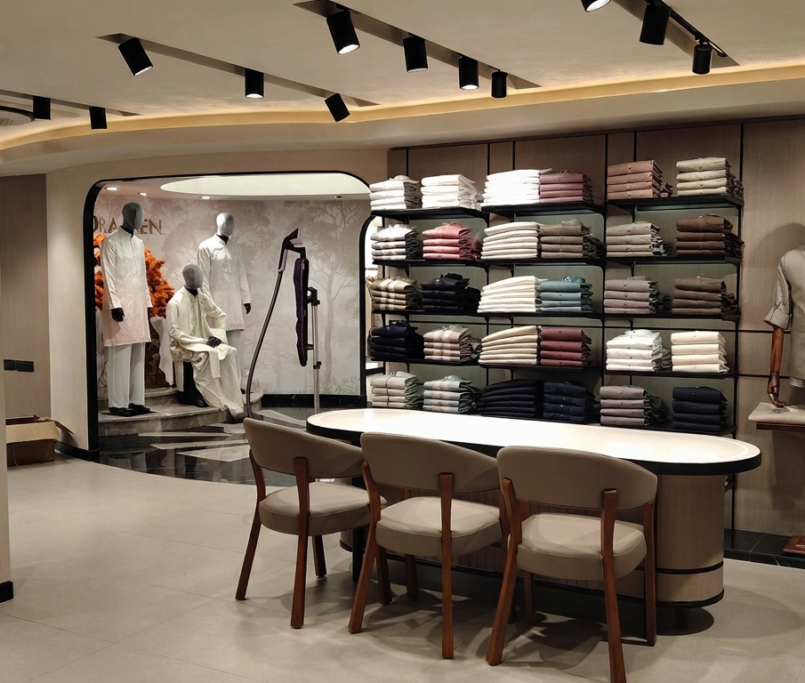
Most apparel showrooms are designed to look good on opening day.
That is the problem.
The photographs go up on Instagram. The launch gets covered. The first weekend is busy. Then the second month arrives. The rail density that worked with 200 SKUs at launch now needs to handle 400.
The folding table near the entry that was supposed to be temporary is still there six months later because there is nowhere else to put the new stock. The trial room queue backs up into the browsing zone on weekends and the whole floor stops converting.
None of this is a product problem. It is an apparel showroom interior design problem that was never asked at the start: what happens when this store actually works?
Velocity Is a Design Spec, Not an Outcome
Here is the thing about high-performing apparel retail that most owners only learn after the first season. Volume changes spatial logic in ways that a static floor plan cannot anticipate.
When ten customers are in the store, a 1.2-metre aisle between rails feels comfortable. When forty are in the store on a Saturday afternoon, that same aisle creates a gridlock that stops people from reaching the back wall. And the back wall in apparel retail is where the highest-margin, lowest-impulse product lives. If customers cannot comfortably reach it, it does not sell.
Apparel showroom interior design that accounts for velocity treats circulation as a primary design variable, not a residual. The question is not “how many rails fit?” It is “how many customers can move through this floor simultaneously without the space working against itself?”
These are different questions with different answers.
The Scalability Gap
Scalability in an apparel showroom is a specific problem. It is not about making the store bigger. It is about designing a space that can absorb operational changes without requiring structural rework every time something shifts.
Three things change in a growing apparel brand faster than the store can typically adapt to:
First, the SKU count grows. A brand that launches with a single category adds adjacent categories within twelve to eighteen months. The fixtures designed for shirts need to handle jackets. The display wall built for one fold height needs to accommodate a different fold. If the fixture system is not modular, every expansion is a cost.
Second, the merchandise strategy changes. What sells in the first season informs how the floor gets laid out for the second. A brand that discovers its accessories category converts at twice the rate of its basics wants to move accessories to the entry zone.
A brand that cannot rezone without a carpenter and a week of disruption is a brand that moves slowly in a market that does not wait.
Third, the team changes. A store with five staff members has different supervisory sightlines than one with twelve. Counter placement, office-to-floor access, back-of-house connection: these are people-flow decisions as much as design ones.
Why Apparel Specifically Punishes Bad Spatial Logic
Clothing is tactile retail. Customers need to touch, hold, compare, try. That sequence takes time and space, and it happens simultaneously across the floor during peak hours.
A bookstore customer can browse with two inches of personal space. An apparel customer cannot make a purchase decision standing sideways in a crowded rail section. The moment the floor feels congested, a specific psychology kicks in. People stop exploring. They either grab the first acceptable option or they leave. Neither outcome is good for average transaction value.
Apparel showroom interior design that takes velocity seriously designs for peak, not average. The average Saturday afternoon is not the design case. The Saturday before a festive weekend is the design case. That is when the conversion rate either holds or collapses, and it holds or collapses based on whether the floor can handle the load.
This requires wider primary aisles than feel comfortable on a quiet Tuesday. It requires trial room capacity that looks like overkill until it isn’t. It requires a counter position that can handle three simultaneous transactions without creating a secondary queue that spills into the merchandise zone.
The Fixture Conversation Most Brands Skip
Custom fixtures are not a premium option in apparel retail. They are a function of fit.
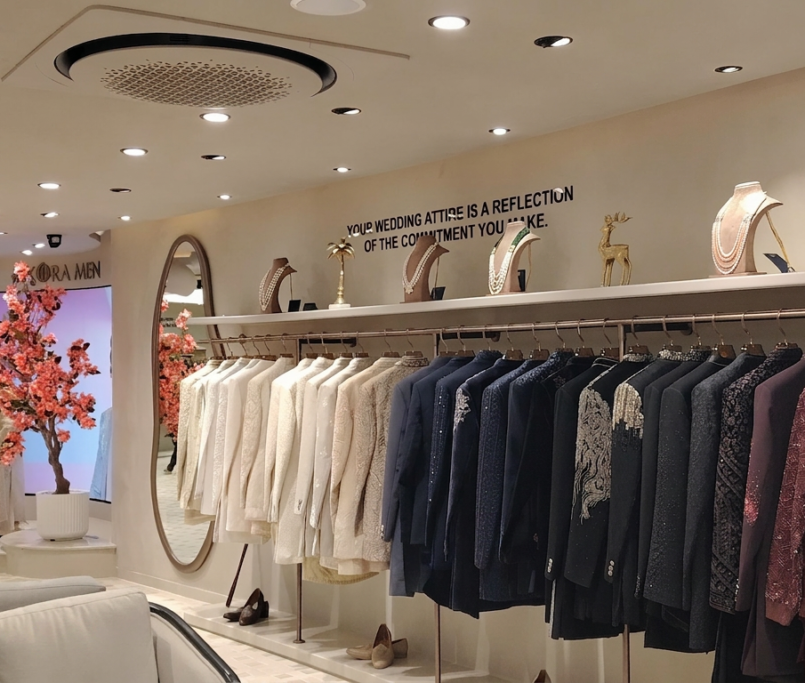
An off-the-shelf rail system is built for generic merchandise at generic dimensions. An apparel brand with a specific fold height, a specific hanger spacing requirement, or a specific material story cannot express that through catalogue furniture.
The brand that sells sustainable linen basics and the brand that sells structured occasion wear have fundamentally different fixture requirements, even if they share the same store footprint.
More practically: off-the-shelf fixtures are not modular in ways that match real operational needs. They are modular in ways that match the manufacturer’s production logic. Shelves that adjust at 5-centimetre intervals do not help if your product needs 7.
Apparel showroom interior design done with manufacturing capability in the same process means fixtures are built to the actual merchandise spec, not adapted from a catalogue after the fact. The difference is visible on the floor and measurable in how quickly staff can maintain display standards across a busy trading day.
Scalability Is a Conversation Most Design Briefs Don’t Have
Here is what tends to happen in a typical apparel store brief. The owner describes the brand. They show reference images. They talk about the customer they are trying to attract. They discuss the budget. Somewhere in that conversation, a timeline gets set.
What rarely gets discussed: what does this store need to be able to do in two years that it does not need to do today?
That question changes decisions across the entire brief. It changes the fixture system. It changes the electrical plan, because a store that will add a digital display wall in eighteen months needs the cabling for it now, not later. It changes the counter specification, because a brand that will add two POS terminals needs a counter designed for three from day one.
Asking the two-year question is not about over-specifying a build. It is about avoiding the specific and very expensive problem of refitting a store that was designed for a business that no longer exists.
What the Right Build Partner Actually Does
Atmosphere builds commercial retail environments with design, prototyping, manufacturing, and fit-out inside one process. For apparel showroom interior design specifically, that integration changes the outcome in a concrete way.
When the designer and the manufacturer are on the same team, the fixture system is designed to the brief, not selected from a range. When the fit-out team has access to the same drawings the design team produced, there is no translation loss between what was specified and what gets installed.
When a brand needs to reconfigure a zone six months after opening, the same team that built it knows the system and can adapt it.
This is not a pitch for seamlessness. It is a pitch for accountability. In a fragmented build, nobody owns the outcome. In an integrated one, one team does.
If you are planning an apparel showroom and the brief has not yet asked what the store needs to do at three times your opening-day volume, that is the conversation to start. The space you build in the next ninety days will either make that growth easy or it will make it expensive.