Jewellery retail is an unforgiving category to get wrong.
The customer standing in front of a display counter is not just evaluating a piece of jewellery. She is evaluating the brand’s confidence in itself – through the quality of the light falling on the product, the way the counter is proportioned, the texture of the surface under her hands, the sense of calm or noise the room produces. All of that communicates before a single word is spoken by a salesperson.
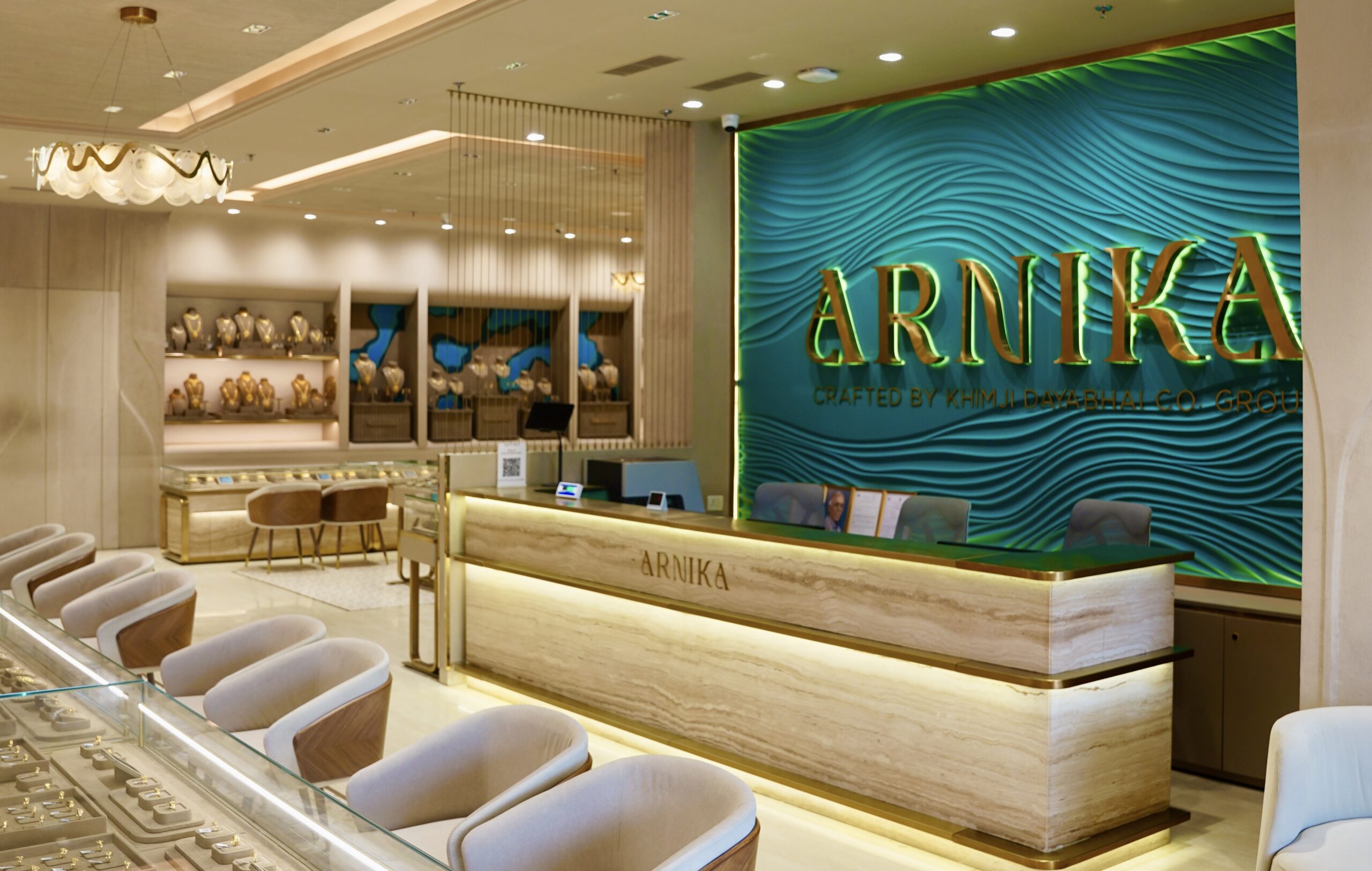
This is precisely why the Arnika design & build by Khimji Dayabhai Group in Bhubaneswar was approached the way it was. A 2,720 sq. ft. flagship. A brand carrying 89+ years of group legacy stepping into a modern retail format. And a design brief where every decision had to serve both those realities at once.
Why Integrated Design And Build Matters More In Jewellery Than Almost Anywhere Else
Split the design from the build – hand off the concept drawings to a separate contractor – and something always gets lost in translation. In fashion retail, that loss is sometimes recoverable. In jewellery retail, it rarely is.
Here is why the gap between designed intent and built reality is so costly in this category specifically:
- Lighting decisions cannot be made in isolation from joinery: The angle and quality of light on a jewellery display depends entirely on how the display case is built – its height, its depth, the material of the top surface. Change one and the other stops working.
- Materiality is felt before it is seen: A customer leaning on a counter that does not feel solid will register that subconsciously and associate it with the brand. Material specifications and build quality are not separable problems.
- Spatial flow affects purchase behaviour: The distance between counters, the width of movement zones, the placement of seating – these are design decisions that the build either honours or compromises. With a separate contractor, the compression starts at a tender stage.
When design and build are integrated under one team from day one, these decisions are made together, tested against each other, and protected through to handover. That is the only way a jewellery environment comes out coherent.
What Coherence Actually Looks Like In A 2,720 Sq. Ft. Space
Coherence in retail design is not about matching everything. It is about every element knowing its role.
The Arnika design & build by Khimji Dayabhai Group was structured around three spatial principles: clarity, flow, and restraint.
Clarity meant that the layout communicated product hierarchy without signage doing the heavy lifting. A customer walking in should instinctively understand where to go and what she is likely to find there. This requires spatial planning decisions made at the brief stage – not at the fit-out stage.
Flow meant that movement through the store felt guided without feeling prescribed. The zoning creates distinct areas while allowing the overall space to feel generous. Openness and segmentation held in balance – each zone defined, but none of them feeling like a separate room.
Restraint is the hardest one to build for. Clean lines, controlled materiality, details that are purposeful rather than decorative. This kind of design does not announce itself. It steps back so the product can step forward. Getting it right depends on the manufacturing team understanding the design intent deeply enough to protect it at the level of the last screw – which only happens when design and manufacturing sit within the same scope.
Legacy Brands And Modern Retail Formats – A Real Design Tension
The Khimji Dayabhai Group brings 89+ years of trust to Arnika. That heritage is an asset. It is also a design brief in itself.
The risk with legacy brands entering modern retail formats is that they resolve the tension between old and new by splitting the difference. The result is a space that is neither – not traditional enough to carry the heritage signal, not contemporary enough to attract the customer the new format is supposed to reach.
The Arnika design & build by Khimji Dayabhai Group did not split the difference. The design language is modern and composed. It does not reference the past through decorative motifs or period detailing. Instead, it carries the credibility of legacy through precision – in the build quality, in the material selection, in the way the space holds itself.
That is a more sophisticated approach, and it requires a team that understands the brand well enough to make that call confidently.
What Other Indian Jewellery Brands Should Take From This
Bhubaneswar is a market that rewards considered retail environments. The customer here is discerning, loyal when earned, and attentive to detail in a way that flagship markets in metro cities sometimes underestimate.
Opening a jewellery flagship in a Tier 2 city is not a reason to compromise on the quality of the retail environment. Often it is the opposite – in markets where word-of-mouth carries more weight, the store itself does more of the brand-building work.
A few things that carry beyond this specific project:
- Integrated design and build is not a luxury – it is a risk-reduction decision
- In jewellery retail, every material and lighting specification is a brand decision
- Restraint in design language is harder to execute than ornamentation and pays back longer
The Arnika design & build by Khimji Dayabhai Group is a good example of what a modern jewellery flagship looks like when the brief is taken seriously from concept through to the last day of construction.
Conclusion
At Atmosphere, we partner with jewellery brands, fashion houses, and hospitality businesses across India to deliver spaces where design integrity survives the build process intact. If you are planning a new flagship or a retail rollout, we would be glad to talk through what that looks like for your brand.
FAQs
1. What is the benefit of an integrated design and build approach for jewellery retail stores?
An integrated design and build approach ensures that every aspect of the store, from lighting and display counters to materials and customer flow, works together seamlessly. This helps maintain design consistency and delivers a cohesive brand experience from concept to completion.
2. Why is lighting so important in jewellery store design?
Lighting plays a critical role in how jewellery is displayed and perceived. Well-planned lighting enhances the brilliance of products, improves visibility, and creates an environment that encourages customers to engage with the collections more confidently.
3. How does store layout influence the customer experience in a jewellery showroom?
A thoughtfully designed layout helps customers move comfortably through the space while clearly showcasing different product categories. Effective zoning and circulation improve navigation, encourage exploration, and support a more relaxed shopping experience.
4. How can legacy jewellery brands balance heritage with modern retail design?
Legacy brands can maintain their heritage by focusing on quality, craftsmanship, and customer trust while adopting modern design principles that appeal to contemporary shoppers. The goal is to create a space that feels current without losing the brand’s identity.
5. Why is design consistency important in a flagship jewellery store?
Design consistency helps reinforce brand credibility and creates a memorable customer experience. When materials, lighting, displays, and spatial planning work together cohesively, customers perceive the brand as more professional, trustworthy, and premium.