Regulars do not just happen. They are designed in.
Every café owner in Mumbai wants the same thing. A space that fills up on weekday mornings, stays active through the afternoon, and has visible buzz on weekends. But the cafés that achieve this are not the ones that spend the most. They are the ones designed around a clear understanding of why someone would choose this space over another nearby.
The best cafe interior designers in Mumbai do not start with aesthetics. They start with intent. Who is this space for, and what does a good hour here look like for that person?
What Mumbai’s café customer is doing in your space
Mumbai’s café culture is fast, layered, and purpose-driven.
Customers are not just visiting casually. They are:
- Working between meetings
- Taking short breaks during long days
- Meeting friends or clients
- Escaping crowded home or office environments
Each of these use cases demands something different from cafe interior design.
A person working for two hours needs comfort, power access, and focus. Someone catching up for forty-five minutes needs energy, proximity, and ease of conversation.
A café designed for only one of these users loses half its potential footfall every day.
The design decisions that actually move footfall
1. Seating that supports multiple use cases
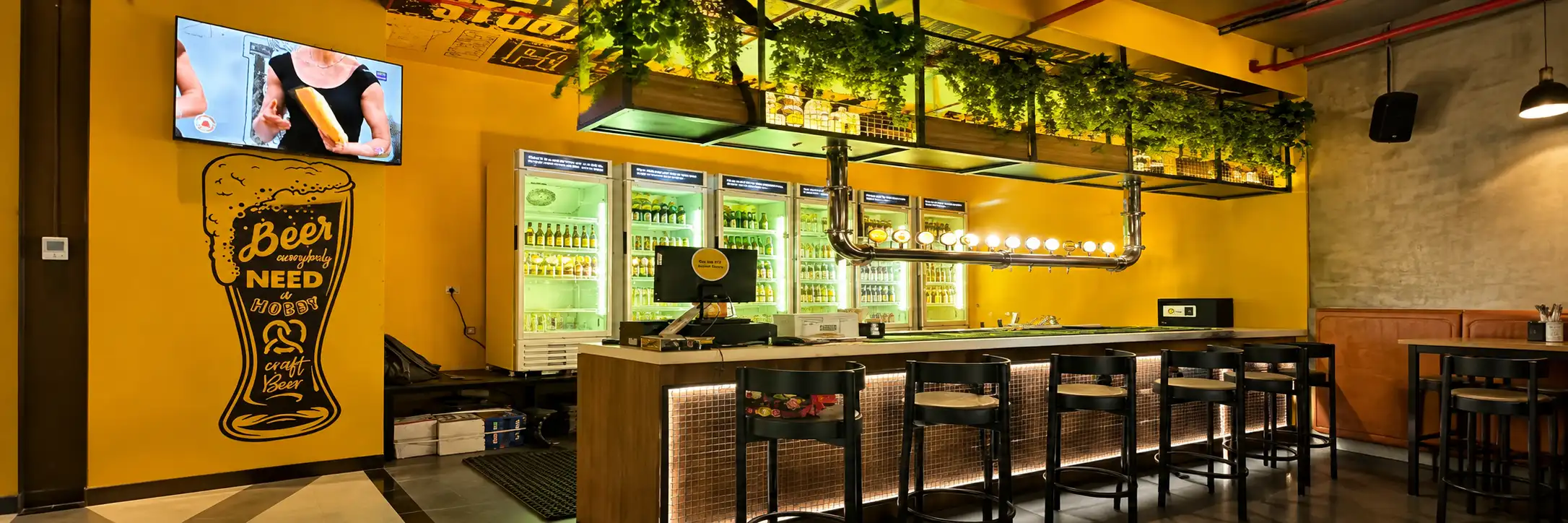
Successful cafés in Mumbai rarely rely on a single seating format.
They create a natural mix:
- Window counters for solo visitors
- Soft seating for longer stays
- Standard tables for quick interactions
- Flexible group arrangements
This is not decorative. It is commercial. It allows the same space to serve different customers throughout the day.
The strongest Cafe interior designers in Mumbai treat seating as a strategy, not just layout.
2. Acoustic comfort as a retention tool
Noise is one of the biggest reasons customers do not return.
Mumbai cafés often operate in dense environments with reflective materials like glass, tile, and concrete. Without proper planning, sound builds quickly.
Effective hospitality fit-out services address acoustics at the design stage using:
- Upholstered seating
- Fabric panels
- Timber surfaces
- Balanced layout planning
Customers may not describe it clearly, but they return to places where conversations feel effortless.
3. Lighting that adapts through the day
Many cafés are designed for one moment, usually in the evening.
But Mumbai cafés operate across long hours.
Spaces that sustain footfall use layered lighting:
- Brighter, functional lighting during the day
- Warmer, softer lighting in the evening
This shift supports both productivity and relaxation. It improves dwell time without requiring major investment.
What Mumbai’s neighbourhood dynamics mean for design
Mumbai is not one uniform market. Each area behaves differently.
- Bandra and Juhu focus on lifestyle and social visibility
- Lower Parel and BKC cater to professionals and business meetings
- Andheri and Powai blend residential and working audiences
- Colaba and South Mumbai attract a mix of tourists and locals
Top cafe interior designers in Mumbai design with these differences in mind.
A café in BKC needs efficiency and comfort. A café in Bandra needs personality and presence. The same design approach does not work everywhere.
The role of hospitality fit-out services in execution
Design intent is only half the story. Execution determines whether the space performs.
Many projects follow a design-first, build-later approach. This often leads to compromises.
Custom elements like seating, counters, and lighting are rarely built exactly as designed when handled by disconnected teams.
Strong hospitality fit-out services integrate design and execution.
- The same team understands the concept and builds it
- Dimensions remain accurate
- Materials are used as intended
- Quality remains consistent
This alignment reduces errors and improves final output.
Common mistakes that limit performance
These issues appear frequently and affect long-term footfall:
- Seating that looks good but feels uncomfortable
- Poor counter positioning causing crowding
- Ignoring acoustic treatment
- Flat lighting that does not adapt to time
- Designing for visuals instead of usability
Each of these reduces repeat visits, even if the café looks appealing at launch.
What separates cafés that sustain footfall
In Mumbai, sustained success comes from repeat customers.
Customers return when the space feels right without needing explanation.
- Comfortable seating
- Balanced sound environment
- Thoughtful lighting
- Smooth spatial flow
The best cafe interior designers in Mumbai focus on these invisible factors.
The real takeaway
A café is not built for the first visit. It is built for the hundred visits.
Strong cafe interior design creates spaces that people choose repeatedly.
And the right hospitality fit-out services ensure that what is designed is exactly what gets built.
That combination is what turns a café into a habit.