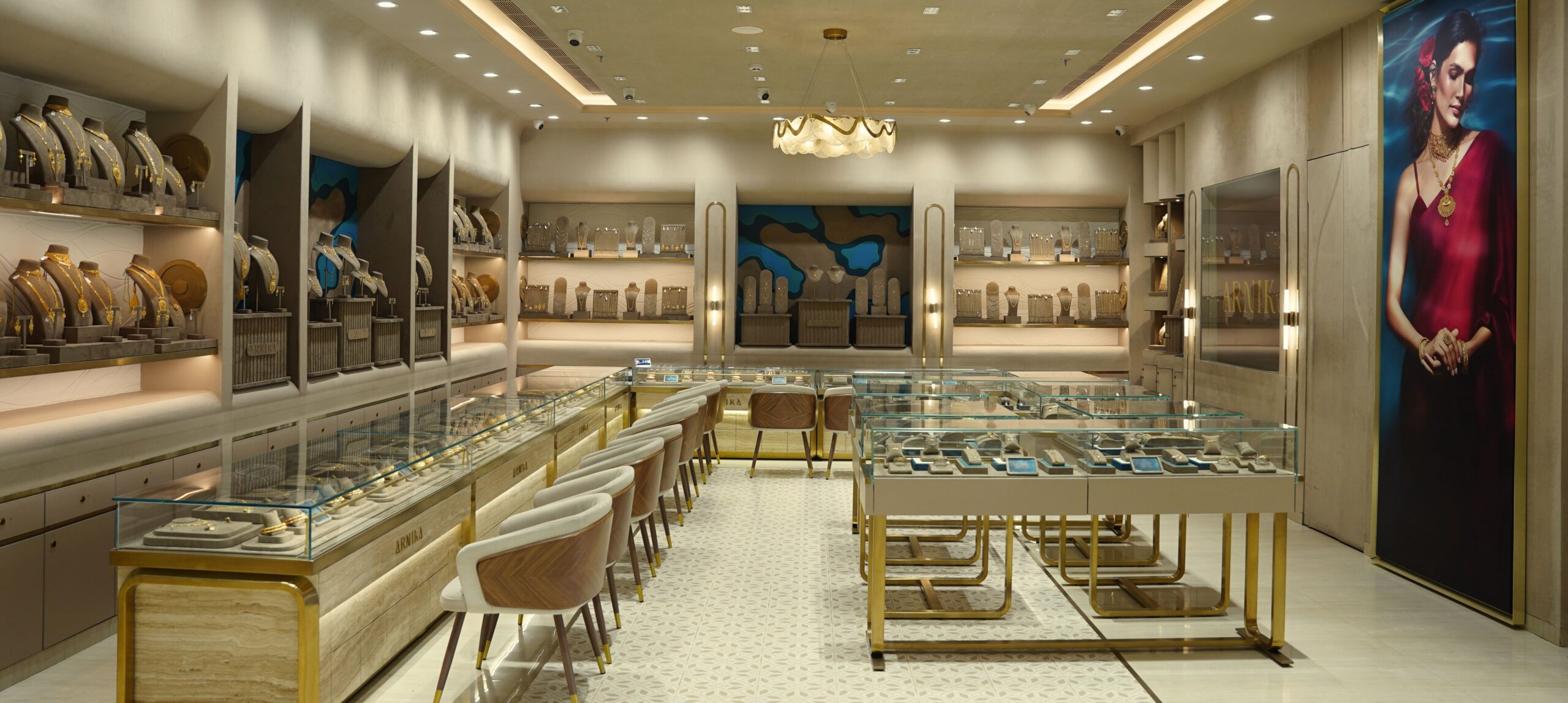
Walk into the right jewellery showroom and something shifts before anyone speaks to you.
You cannot always name it. The ceiling height. The way a single pendant catches light on a piece behind glass. The fact that the floor does not echo. These things are not accidents.
They are decisions, made by people who understand that in a jewellery showroom, every square foot is doing two jobs at once: selling trust and selling desire. Getting one wrong dismantles the other.
The Brief Nobody Says Out Loud
Jewellery showroom owners rarely frame the brief this way, but here is what they actually need: a space that makes strangers feel safe enough to spend large amounts of money on something they will wear for decades.
That is a strange design problem. It requires the room to communicate security without communicating with the fortress. It needs to signal exclusivity without making a first-time buyer feel like they’ve walked into the wrong place. It has to do all of this without anyone noticing the design at all.
The best jewellery showroom interior design is invisible in exactly this way. Guests remember the ring. They do not remember why the room made them feel ready to buy it.
Security Is a Design Decision, Not an Add-On
This is where most showroom builds go wrong.
The owner signs off on a beautiful space. Then, six weeks before opening, the security consultant arrives. Cameras go in wherever cables can run. The panic button ends up behind the wrong counter. The vault placement was not considered when the floor plan was drawn. Now the staff have to carry trays of high-value pieces across 14 metres of open floor every evening.
Security retrofitted onto a finished space looks exactly like what it is. And in a jewellery showroom, anything that looks improvised chips away at the confidence a buyer needs to feel.
The right approach builds security into the spatial logic from the first sketch. Where do counters face? Where do the sight lines from each staff position land? Which entry points have natural chokepoints? How does the back-of-house connect to the display floor without crossing through the public zone?
None of this is visible to a customer. That is the point.
What Luxury Actually Requires from a Room
Luxury in a showroom is not about expensive materials. It is about proportion, restraint, and silence.
Silence as a design concept is underused. A showroom that absorbs sound does something a loud one cannot: it slows people down. When the ambient noise is low, conversations feel private. Private conversations produce decisions. This is not anecdotal. High-converting jewellery floors in markets like Jaipur, Surat, and Mumbai share this quality. The room does not compete with itself.
Consider what jewellery showroom interior design actually has to manage simultaneously.
The Lighting Problem Nobody Talks About Enough
Jewellery lighting is its own discipline, and it gets treated like an afterthought far too often.
The wrong colour temperature makes yellow gold look brassy. It makes white gold look cold. It makes diamonds appear smaller than their certificate says they are. A buyer who does not consciously understand colour temperature will still feel it. The piece “doesn’t look right.” They leave to think about it. They do not come back.
Correct jewellery lighting requires layering. Ambient light sets the mood of the room. Accent light hits the pieces in the display cases at an angle that produces the maximum amount of scintillation without creating glare. Task light at the counter gives staff and buyers accurate colour reference when a piece comes out of the case.
These three light sources need to be calibrated together, which means the electrical plan, the case design, and the counter specifications have to be resolved by the same team. When they come from different vendors working off different drawings, the calibration never quite works.
The Fixture Problem Is a Manufacturing Problem
Custom fixtures in a jewellery showroom are not a luxury. They are a requirement.
Off-the-shelf display cases are built to generic dimensions for generic products. A jewellery collection is not generic. The tray depth, the glass angle, the lock placement, the internal lighting position: all of these affect how individual pieces present.
A necklace that hangs at the wrong depth in a case looks smaller. A ring displayed flat instead of angled loses its profile.
Getting this right requires a manufacturer who builds to the designer’s specification rather than a catalogue. And it requires that manufacturer to be working from the same brief as the designer, not receiving a PDF three weeks after the design was finalised.
Jewellery showroom interior design that produces genuinely high-converting display environments is always the result of design and manufacturing talking to each other from the start.
The Showrooms That Get This Right Share One Thing
They are built by a single team that holds the whole problem.
Not a designer who hands off to a contractor. Not a contractor who orders furniture from four vendors. Not a security consultant who arrives after the floor plan is done. One integrated process, from the spatial logic of the floor plan to the fixture that holds the piece that closes the sale.
I keep returning to this because it is obvious in theory and rare in practice. Every stakeholder in a fragmented build is optimising for their own scope. Nobody is optimising for the outcome: a room that makes a customer trust the brand, feel at ease, and say yes.
Where Atmosphere Fits
Atmosphere builds commercial spaces across retail, hospitality, and jewellery, with design, prototyping, manufacturing, and fit-out under one roof. For jewellery showroom interior design specifically, that integration matters more than it does for almost any other category.
A showroom is not a restaurant. The stakes per square foot are higher. The margin for error on fixtures, lighting, and security integration is lower. A display case that does not perform costs more than the case itself.
If you are building or refreshing a jewellery showroom, the conversation worth having is not about aesthetics first. It is about who holds the whole problem.