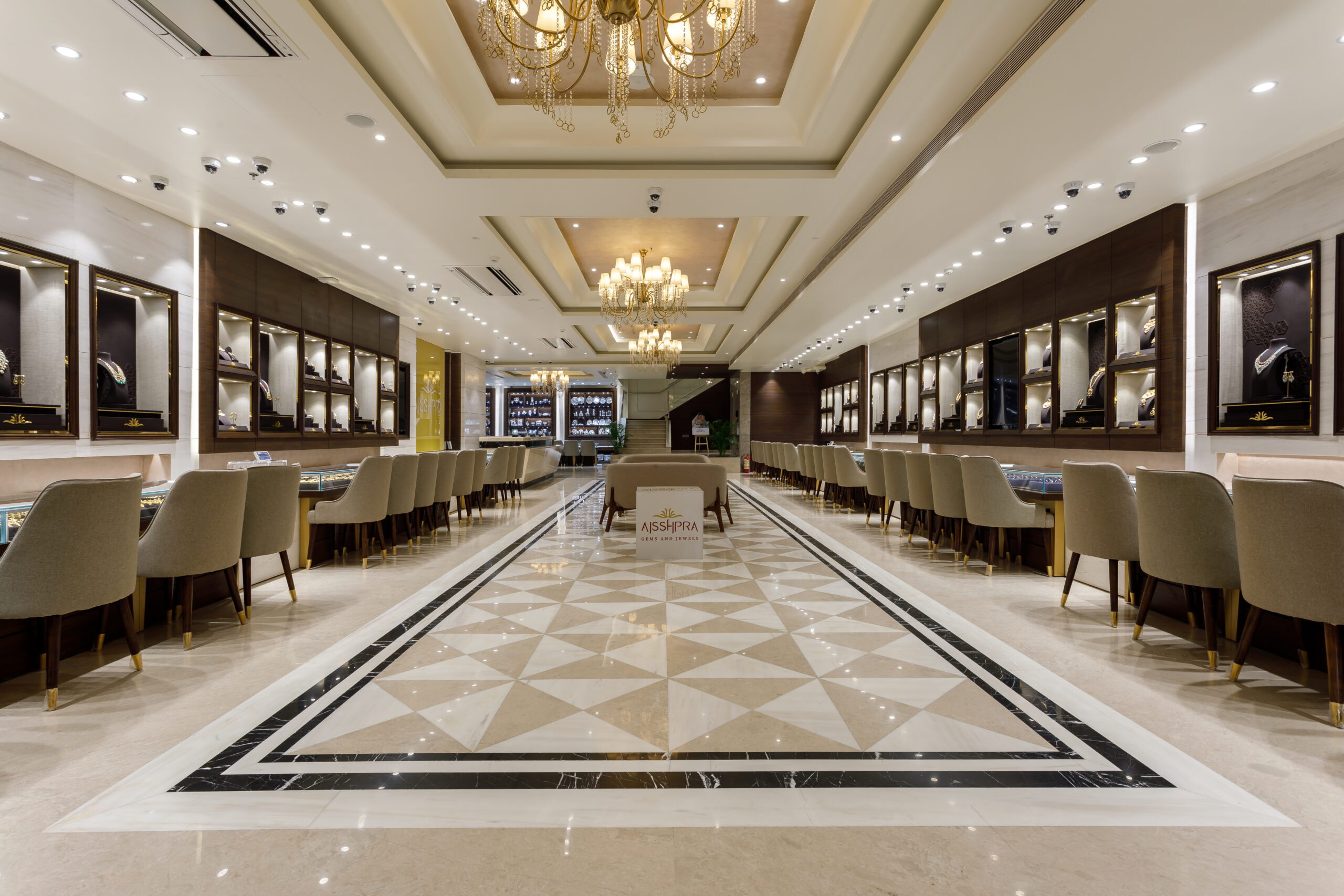
Jewellery is the most spatially demanding category in retail. The product is small. The price points are high. The purchase decision is slow, emotional, and acutely sensitive to how safe and unhurried the customer feels. Jewellery showroom interior design carries more commercial weight per square metre than almost any other retail format, and the margin for error is correspondingly narrow.
This guide covers the three variables that determine whether a luxury jewellery store performs: layout, lighting, and display. Each one is specific. None of them is optional.
Layout: Earn Trust Before You Earn Attention
Most retail layouts are optimised for product exposure. Jewellery retail works differently. Before a customer will engage meaningfully with a product at this price point, they need to feel comfortable, unhurried, and attended to without being watched. The layout either creates that feeling or it doesn’t. There is no middle ground.
The decisions that build it:
- Generous space near the entrance, compressed approaches signal pressure. A clear entry tells a customer that browsing is welcome.
- Counter configurations that allow staff to move alongside customers, long unbroken counters position staff as barriers. Angled layouts let the conversation happen side by side.
- Zoning by customer intent, bridal, everyday fine jewellery, and high-value pieces each draw a different customer in a different state of mind. A single undifferentiated floor plan forces navigation through the wrong product before reaching the right one.
- Accessible seating near display counters, a customer who sits down has decided to spend time. That decision converts.
Luxury jewellery store interiors that perform consistently are designed around this sequence: comfort first, product discovery second.
Lighting: The Decision That Cannot Be Reversed Later
Layout determines movement. Lighting determines what a customer feels and what the product looks like. In jewellery retail those two things are not separable.
Standard downlighting at typical retail lux levels illuminates a space. It does not make diamonds appear to move, it does not render warm gold tones accurately, and it does not create the depth in coloured stones that justifies a high price tag. Lighting in a jewellery store is not a finishing-stage decision. It belongs in the brief at the same time as the floor plan.
The approach that works:
- Accent lighting aimed at display cases at 30 to 45-degree angles, this produces the scintillation effect in stones that flat downlighting eliminates entirely
- Warm white sources (2700K to 3000K) for yellow gold and rose gold, cooler light washes out warm metal tones and makes them read as cheaper than they are
- Neutral white (3500K) for white gold, platinum, and diamonds, accurate without the clinical quality of higher colour temperatures
- Lower ambient levels than most retailers feel comfortable specifying, a darker ambient directs attention to the cases rather than the ceiling and walls. It also communicates exclusivity in a way that brightly lit spaces simply do not
- No light sources in the customer’s direct sightline, glare causes discomfort and shortens dwell time. Every accent source should illuminate the product, not announce itself
Display: A Precise Brief, Not a Furniture Decision
Retail store fixtures in jewellery retail carry a specific functional requirement. They present high-value objects in a way that communicates their worth, enables close examination, and allows staff to retrieve and present pieces cleanly during a sales conversation.
Off-the-shelf cases are built to a generalised retail brief. That brief does not account for the specific angles customers view jewellery from, the internal lighting placement needed to eliminate dark rear corners, or the tray depth calibrations that make different product categories readable at a glance.
What bespoke fixture specification resolves:
- Internal lighting positioned to reach the full depth of each case, not just the front third
- Glass specification that reduces reflections at the angles customers most commonly view from
- Tray configurations matched to product mix, shallow for rings and earrings where top-down visibility matters, deeper for pendants and bracelets
- Exterior surface finishes durable enough to handle constant contact without showing wear within the first year
The supporting elements, display plinths, wall-mounted shadow boxes, window installations, need the same rigour as the cases. A poorly finished plinth beneath a well-lit display is a visual inconsistency that reads as a brand not fully committing to its own positioning.
Why the Full Scope Matters
Layout, lighting, and display deliver the intended result when designed and built as one integrated scope. When split across separate contractors, interior designer, electrician, fixture supplier, the decisions in each workstream rarely account for the others. Lighting specified independently of fixture design creates shadows in the wrong places. Fixture dimensions not coordinated with the floor plan produce circulation problems that no amount of styling resolves.
Retail fit out services that hold the full scope under one team allow those decisions to compound rather than conflict.
Atmosphere in Jewellery Retail
Atmosphere.work has delivered store environments for Candere, Arnika by Khimji Dayabhai Group, Adamantine, Akoirah, Aisshpra Gems and Jewels, Kushal’s Fashion Jewellery, Solitario Diamonds, and Everlume Lab-Grown Diamonds, spaces where the fit-out needed to communicate brand positioning and support considered, high-value purchase decisions.
Custom display cases, counters, plinths, and joinery are manufactured in-house. The design team manages spatial planning, lighting integration, and installation under one scope.
If you are planning a jewellery showroom fit-out, speak to Atmosphere before the material specifications get locked in.